A fungal foray with John Wright is not mushroom hunting as I know it. Childhood memories of my mother’s picnics and my father whistling to keep hunters away are miles from a day at the Kingcombe Centre in West Dorset.
There are similarities of course. Baskets, knifes, eyes to the ground, a reassuring smell of decay when the nose gets closer to the undergrowth and that warm feeling of joy when a mushroom is found. Or a toadstool.
The point of taking part in a foray with Mr Mushroom himself is to learn. There were a few newbies like me and a few reoffenders who clearly thought it was worth re-foraging with Mr Wright. The world of fungi is a vast underground world where the initiated want to learn more and the foodies don’t want to go home empty handed.
Our foray was at the Kingcombe Centre in West Dorset, part of a Nature Reserve where the fields have never seen fertiliser, where the preservation of our local ecosystem is not a fashion. A very special place not just for the lucky visitors but also for the underworld. The 75 different types of fungi we found in about four hours should prove my point. Only one do I uncompromisingly know, a very exciting one at that, a chanterelle.
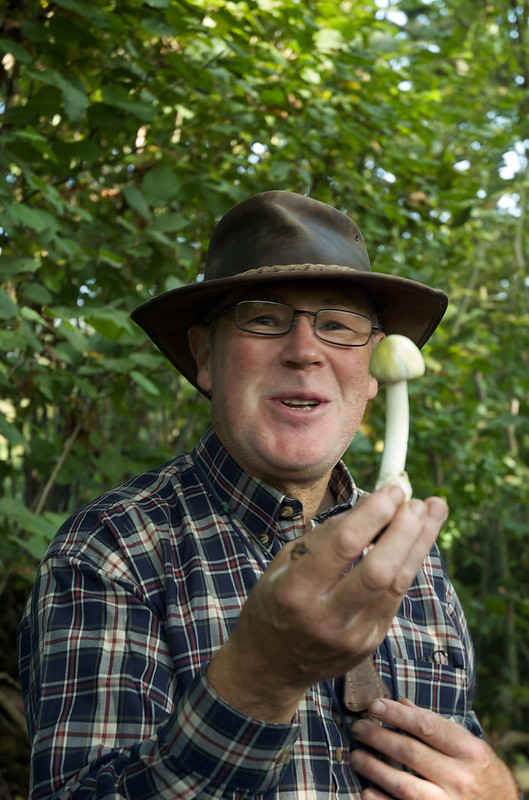
Our first lucky find in the hedge outside Kingcombe Centre was tall, thick stemmed, white with a greenish cap. It brought a big smile to John’s face as he dug it from the ground, bag at the base and all. He proudly showed the group and introduced us to the one mushroom you should avoid at all costs: The Death Cap. Need I say more. Not as pretty as its red and white cousin that fairies are keen on but more dangerous.
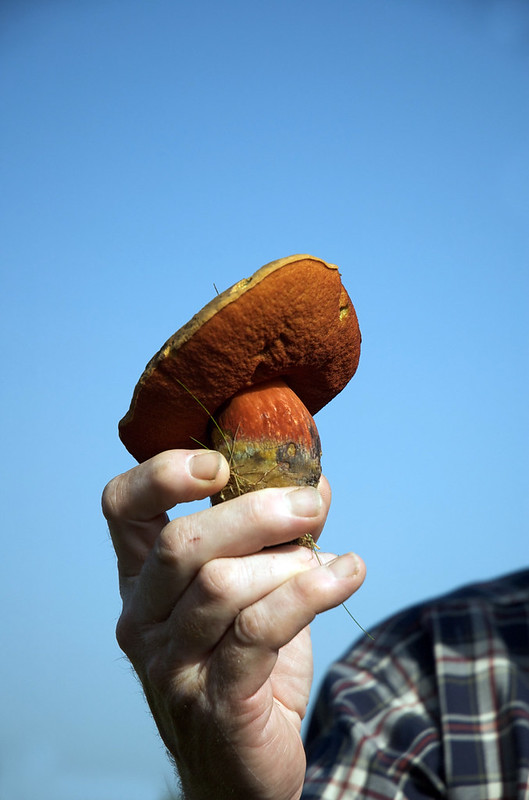
Of the remaining 73, I had come across a few but could sadly name none fully. English name or latin name. A beautifully fat boletus find was quite exciting. Being red though, it was totally the wrong colour for supper but perfect for a photo opportunity. John obliged by holding it up against the cloudless blue sky.
I still don’t know the difference between a toadstool and a mushroom. I might be the proud owner of a signed copy of the River Cottage Handbook No. 1 (John commented that he was honoured to sign his ‘Mushrooms’ book for a Française, cheeky charmer) but to me, they’re still all Champignons. All 4,000 species that you can find in Britain.
I learnt lots of interesting facts about fungi. For a start, they are the reproductive organ of a world that lives underground. From there, inevitable sexual innuendoes follow. How about the nipples on the magic ones that can take you to seventh heaven or leave you sorely disappointed and a carefully pronounced volva at the base of the hard stem of the Amanita phalloides. I’ll leave it at that, not my forte, I was brought up by a Catholic mother who was master picnic organiser but stayed away from such language. John on the the hand was far more masterful with his words, let alone knowledge, and had us giggling throughout the day.
A few titbits I gathered were of far greater interest. The reason mushrooms are often found at the edge of a wood or near a car park is not, as I thought, because mushrooms need a bit of sunshine to warm their caps but because the organism that lives under the ground is suddenly worried that the environment it is thriving in is running out. Time to reproduce and out come the fruits for spores -babies in the making- to be scattered, and for animals to pick, munch or nibble.
Of far more interest for my stomach is that the mushrooms my family still hunt for, once the first rains have blessed the sunny South of France and its pine and oak forests, can be found in this country. The Saffron Milkcap. For once, the clue is in the Latin name: Lactarius deliciosus. I found one years ago, somewhere in the South West and John confirmed you can find them in this country. I wasn’t dreaming after all.
Should I tell you where? If a delicious mushroom is to be found, should its location be shared? Well, here is one thing the French and the English have in common. My Dorset farmer friend and his father don’t share their secrets for Field Mushrooms hotspots with each other. My family don’t divulge their pine forest autumn picnic locations to all and sundry.
It looks like I will be spending the next few years hunting in pine and oak woods of Dorset to leave my children our own little mushroom secrets. I’ll be thanking John for renewing my love of the forest undergrowth, his little book in my basket, keeping away from beautiful white tall mushrooms with a volva.
—
John Wright shows off the Death Cap:
Photogenic Boletus:
Kingcombe Centre courses:
http://www.kingcombe.org/courses/intro.aspx
 Pardon my Franglais