Category: Dorset

A West Dorset Tweetup

West Dorset and Tweetup could be seen as an anachronism. I’ve had a few bewildered looks when I said I was going for my first tweetup. What on earth is it anyway? Well it’s a meetup for tweeters. Simples.

“What is the agenda?” asked @LisaTandem. Good question, although I hadn’t given it much thought. I just wanted to put a real face to people I had met via Twitter; so when @tim_harrap (also known as @BritishCheese) suggested a West Dorset tweetup I tweeted great idea.

The Wild Garlic seemed the obvious place to meet since @matkiwi is a tweeter of note in the foodie twitter world and his restaurant in Beaminster was a nice and convenient venue.

He joined in the twitter spirit:
“Nice idea, coffee on me, all welcome”

So it continued with:
West Dorset tweetup Saturday 11/12 10.30, Wild Garlic in Beaminster. Coffee on @matkiwi (thanks Mat!) @tim_harrap will be there. Who else?

And ended up with @tim_harrap, @MrCliveC, @matkiwi, @natamagat (that’s me!) and @tim_harraps’ oh (other half) discussing the twittersphere over a coffee. Don’t be fooled in thinking that there are only four people tweeting in West Dorset though. There are in fact dozens of us.

Children’s plays and hangovers got in the way, many were working on Saturday morning and the rest were obviously Christmas shopping. And many more don’t follow @tim_harrap or @natamagat so had no idea this West Dorset tweetup was happening.

We all had interesting stories to tell. It would be wrong of me to divulge @MrCliveC’s thoughts on the place of the police in the 21st century. Being the Police Federation Chair for Dorset he needs to handle his 140 characters carefully despite tweeting in a personal capacity. Or indeed what @matkiwi might have to say about intense farming. He is of course against it, I hasten to add, but he had some interesting comments on how the press handle it.

@BritishCheese gave some great examples on how twitter can be used in a large company and introduced me to twitterfall. I added my bit on why journalists have not become lazy as is often perceived but rather pushed in a corner they did not choose.

We all agreed that we look for the people behind the tweets. Corporate marketing and old fashioned PR still have a long way to go in their understanding and use of social media marketing in many companies.

As for our tweetup, I’d say it was a success. We met the real people behind the @names and I’m looking forward to meeting more West Dorset tweeters at the next one. Suggestions welcome.
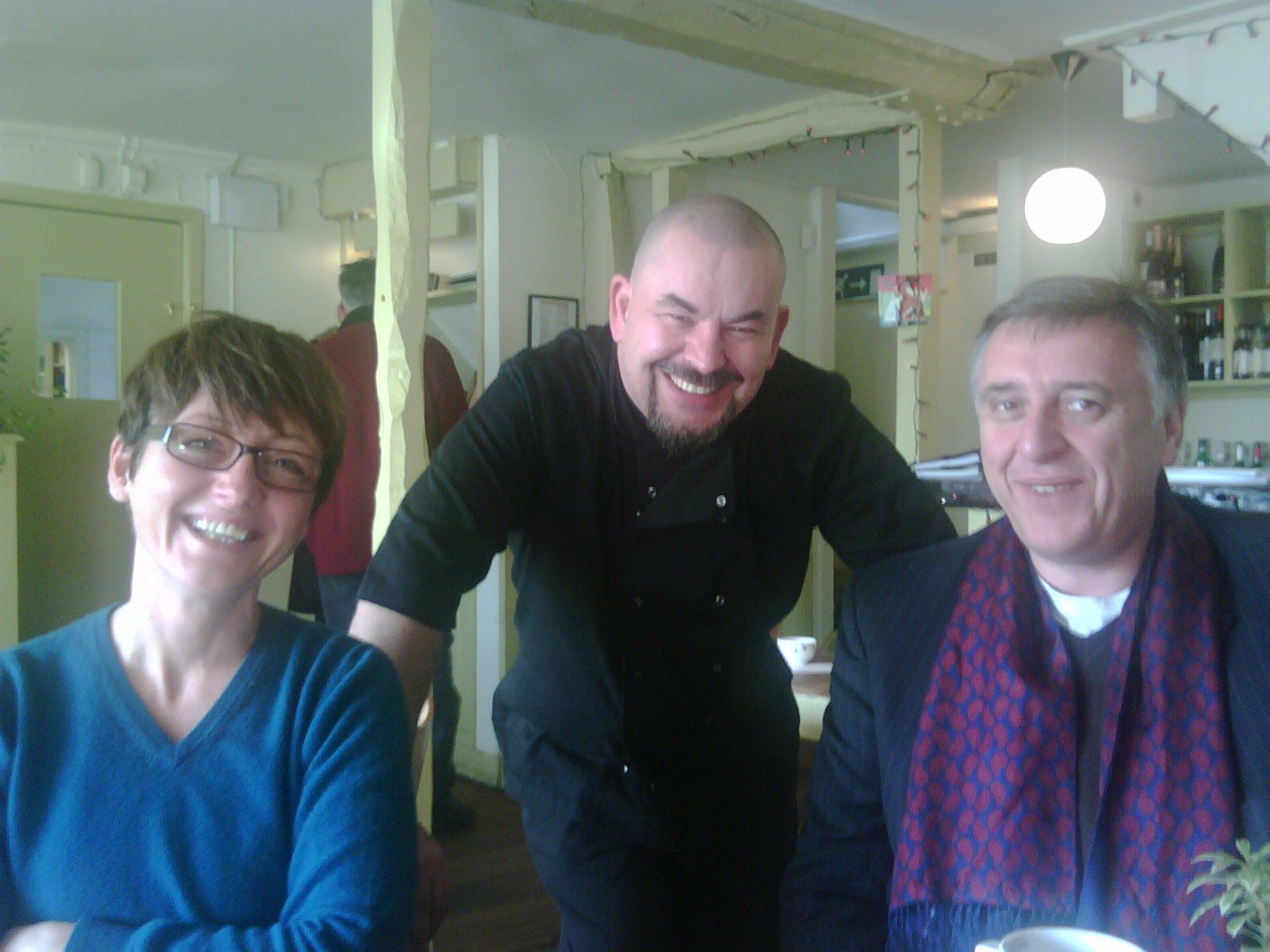
twitpic taken by @tim_harrap

Dorset Turtle Claw Chillies Jelly

My very first attempt at making jelly. If you’re also a newbie, buy a jelly bag. It will need to hang over a bowl for the juices to drip, so prepare a butcher’s hook and make sure your kitchen cupboard door handle is strong enough: I lost a pint of vinegary liquid, it stinks… Or get a fancy jelly bag holder.

Ingredients:
1 kg cooking apples, 500 ml water, 500 ml cider vinegar, 1 lb sugar per pint of juice, chillies (I used about 16 and it was still mild).

First:
In a large pan: chopped apples (including skin and pips for pectin), 500 ml of water, 500 vinegar and 8 chopped chillies. Boil for a couple of mins then simmer for 15 mins. Let it cool a bit.
Kids hated the vinegar smell that invaded the house…
Pour the juice through the jelly bag (do not force or the jelly will be cloudy) and leave to drip overnight.

Next morning:
Prepare 1 lb of sugar per pint of juice. Heat juice on low heat in high sided pan, add the sugar on high heat for 10 minutes for sugar to dissolve. (I kept turning for fear of burning but have read since that you shouldn’t, so up to you). Before taking off the stove, add thinly sliced chillies (I took most of the seeds off), let the liquid cool down a bit and transfer into sterilised jars.

This made a sweet jelly and was not as hot as I thought it would be, next time I’ll put more… The Turtle Claw Chillies are very fruity and taste a bit like the long red sweet peppers you find in supermarkets (only much nicer, with a pleasant kick when you swallow and a typical clear nose afterwards). I also found a recipe with cider rather than vinegar and I’ll try that too being in Dorset and all.
If my guinea pigs like it, I’ll post it here too…

This is based on a recipe by the Chilli King. Check out their website for getting the setting point right (My freezer’s in my garage so I didn’t bother!) and more stuff on chillies.

PS. Try this recipe at your peril, and taste the chillies you’re putting in your recipe before you make four jars of jelly… Have fun, we loved it with lamb, cheese and charcuterie. My son loved it on its own, it’s really quite sweet (the jelly not my teenager).


Fungi foray frolic in West Dorset

A fungal foray with John Wright is not mushroom hunting as I know it. Childhood memories of my mother’s picnics and my father whistling to keep hunters away are miles from a day at the Kingcombe Centre in West Dorset.

There are similarities of course. Baskets, knifes, eyes to the ground, a reassuring smell of decay when the nose gets closer to the undergrowth and that warm feeling of joy when a mushroom is found. Or a toadstool.

The point of taking part in a foray with Mr Mushroom himself is to learn. There were a few newbies like me and a few reoffenders who clearly thought it was worth re-foraging with Mr Wright. The world of fungi is a vast underground world where the initiated want to learn more and the foodies don’t want to go home empty handed.

Our foray was at the Kingcombe Centre in West Dorset, part of a Nature Reserve where the fields have never seen fertiliser, where the preservation of our local ecosystem is not a fashion. A very special place not just for the lucky visitors but also for the underworld. The 75 different types of fungi we found in about four hours should prove my point. Only one do I uncompromisingly know, a very exciting one at that, a chanterelle.

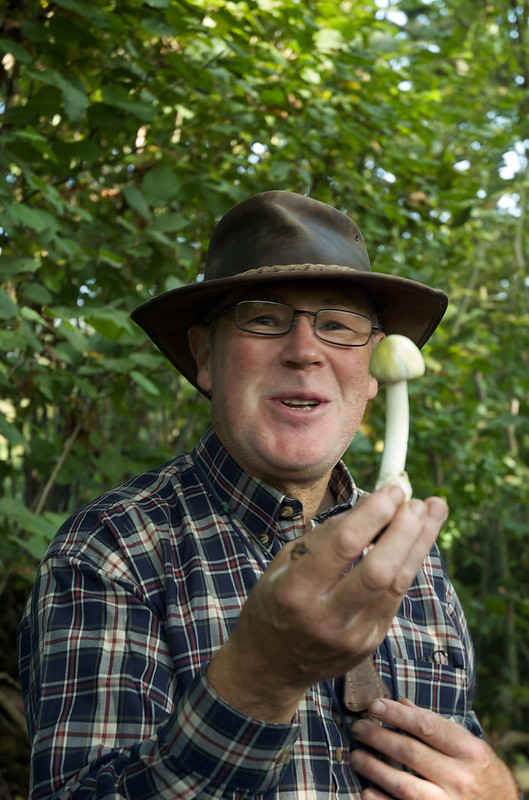
Our first lucky find in the hedge outside Kingcombe Centre was tall, thick stemmed, white with a greenish cap. It brought a big smile to John’s face as he dug it from the ground, bag at the base and all. He proudly showed the group and introduced us to the one mushroom you should avoid at all costs: The Death Cap. Need I say more. Not as pretty as its red and white cousin that fairies are keen on but more dangerous.

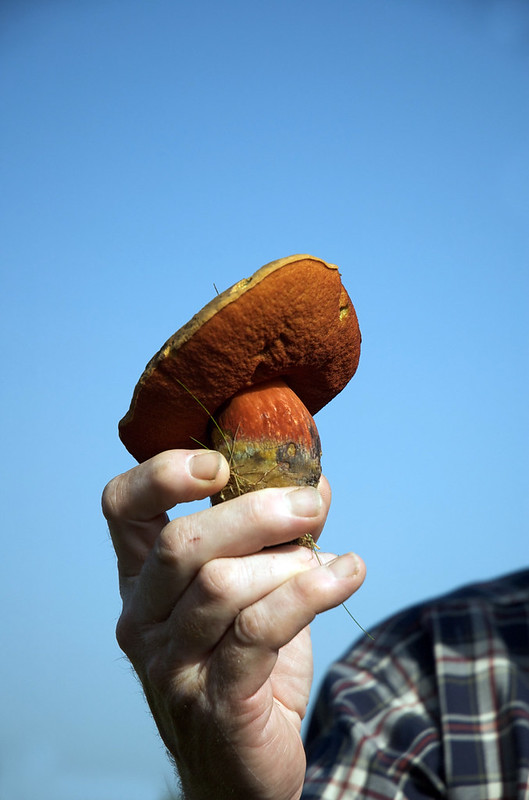
Of the remaining 73, I had come across a few but could sadly name none fully. English name or latin name. A beautifully fat boletus find was quite exciting. Being red though, it was totally the wrong colour for supper but perfect for a photo opportunity. John obliged by holding it up against the cloudless blue sky.

I still don’t know the difference between a toadstool and a mushroom. I might be the proud owner of a signed copy of the River Cottage Handbook No. 1 (John commented that he was honoured to sign his ‘Mushrooms’ book for a Française, cheeky charmer) but to me, they’re still all Champignons. All 4,000 species that you can find in Britain.

I learnt lots of interesting facts about fungi. For a start, they are the reproductive organ of a world that lives underground. From there, inevitable sexual innuendoes follow. How about the nipples on the magic ones that can take you to seventh heaven or leave you sorely disappointed and a carefully pronounced volva at the base of the hard stem of the Amanita phalloides. I’ll leave it at that, not my forte, I was brought up by a Catholic mother who was master picnic organiser but stayed away from such language. John on the the hand was far more masterful with his words, let alone knowledge, and had us giggling throughout the day.

A few titbits I gathered were of far greater interest. The reason mushrooms are often found at the edge of a wood or near a car park is not, as I thought, because mushrooms need a bit of sunshine to warm their caps but because the organism that lives under the ground is suddenly worried that the environment it is thriving in is running out. Time to reproduce and out come the fruits for spores -babies in the making- to be scattered, and for animals to pick, munch or nibble.

Of far more interest for my stomach is that the mushrooms my family still hunt for, once the first rains have blessed the sunny South of France and its pine and oak forests, can be found in this country. The Saffron Milkcap. For once, the clue is in the Latin name: Lactarius deliciosus. I found one years ago, somewhere in the South West and John confirmed you can find them in this country. I wasn’t dreaming after all.

Should I tell you where? If a delicious mushroom is to be found, should its location be shared? Well, here is one thing the French and the English have in common. My Dorset farmer friend and his father don’t share their secrets for Field Mushrooms hotspots with each other. My family don’t divulge their pine forest autumn picnic locations to all and sundry.

It looks like I will be spending the next few years hunting in pine and oak woods of Dorset to leave my children our own little mushroom secrets. I’ll be thanking John for renewing my love of the forest undergrowth, his little book in my basket, keeping away from beautiful white tall mushrooms with a volva.

John Wright shows off the Death Cap:

John Wright's Death Cap

Photogenic Boletus:

Beautiful boletus

Kingcombe Centre courses:

http://www.kingcombe.org/courses/intro.aspx

Basket beauties in Bridport

When tutor Andy asked what type of basket we’d like to make, I can’t say I’d given it much thought before I started the willow weaving course. A last minute booking for a workshop in Highway Farm B&B in Bridport meant I had just turned up in my cotton shirt; and clearly an empty head. Thankfully owner Pauline took pity on me and lent me a fleece.

I racked my sleepy brain for inspiration and a little light came on when I saw a beautiful platter Andy had made. A woman in period costume was picking flowers and putting them softly in a lovely flat basket. The romantic image from a period film seen years ago came flashing back. I knew what I wanted to do.

It quickly transpired that everybody else was doing a properly woven basket and I wasn’t. Virgo Vicki was making a waste paper basket (as a Virgo would), Experienced Ellie was weaving a blackberry beauty, Friendly Florence was longing for a log carrier, Mum Mel was going to fashion hearts for her daughter’s wedding and Chatty Charlie kept changing her mind.

They started weaving a round base in a circular ‘under-and-over’ then added a dozen stiff spokes at regular intervals for the sides. Friendly Florence put the contraption on her head and took a model pose. She wouldn’t have been out of place at Bridport’s Hat Festival. She may have found it a bit inconvenient to circulate around the market with 2 metres long twigs around her head but it was a good giggle around the barn.

Who would have thought basket weaving could be dangerous though? There I was concentrating on my over-under-over-under-ouch-oops, sorry! I had poked Chatty Charlie in the eye. Thankfully, she was able to finish her basket, the only one with a prison-window-with-bars type handles under the rim; rather than the large over the rim number that you rest on your arm; or the two small handles for heavy loads. Once you start looking into willow baskets, you wouldn’t believe the possible permutations.

And once we started weaving our willow baskets, there was no stopping us either. Except I was getting hungry. Pauline had told us to come and have lunch around one-ish and we were getting closer to two-ish. The soup and homemade bread went down a treat among chatter and laughs. Big house down the road being sold, content and all, Hat Festival update, Andy’s moving malarchy and Pauline’s new blog stories. Pauline, if you read this, you did promise a recipe for your pudding…

As for my fancy flower friend (I refuse to call it a trug, ugly name), I am over the moon with the result. I took home a basket like I’ve never seen before and have been looking at twigs from my hedge trimming this weekend in a new light: under-over-under-over.

What shall I make next? Well… since you ask. Pauline does a weekend workshop for hazel garden furniture. I’m on the waiting list hoping someone will change their mind.

Update: Experienced Ellie made a horse’s head the next day, have a look here.

The inn down the lane

From nouvelle cuisine to a country pub down a tarmac lane so remote, it has grass growing on it. The sun is shining so we decide to drive around West Dorset lanes just for the sake of the views and find the Three Horseshoes Inn just around lunch time.

Pub with rooms. The menu is more gastro than old boys’ local and they’ve run out of Bath chaps and Hooke Farm trout. No matter, I fancy a Blue Vinney ploughman and the husband goes for battered cod with triple cooked chips. Yep, good ol’ fish and chips for lunch. Takes all sorts.

We can hear children as we sit down on the terrace with wide green views. You’d think they are just behind the wall, a perfect demonstration of how sound works in amphitheatre. A few minutes later, the school below starts work again for the afternoon so the only sounds left are the birds, the wind in the parasols and a distant dog listening to himself. Otherwise you’d wonder whether there’s much life around.

When my square wooden platter arrives I pull a face. There’s a heap of thin and pretty greenery on the edge and I am wondering how to eat this without half of it ending up on the floor. It looks like young sweet pea shoots and tastes delicious. Brain figures that fingers are de rigueur. If the man in the nice restaurant in France (many years back) thought it was OK for me to eat with my fingers because chefs don’t like plates coming back with food, then why not?

Apart from the juicy shoots, there was a large chunk of blue veined Dorset delight, some very light and airy home made bread and two chutneys. The first was classically vinegary with soft fruits -no crunchy out of a jar sharp stuff here-  the other more of a compote that has not reached mushy state so the soft bits of fruits have a gentle texture. This one would have probably complimented a Farmhouse Cheddar better, Blue Vinney being a bit stronger it overtook the palate (ok, killed the fruits if you prefer).

The husband enjoyed his triple cooked chips and battered cod. The cod portion was large enough and the batter was a bit on the heavy side but the chips were deemed delicious. There is a price to pay for triple cooked chips at lunchtime and I can hear the husband snoozing. You can’t beat a Ploughman in a country pub. And as country pubs go, this one sure has the location, a great terrace with half a dozen tables, the pretty church next door and new owners.

Our terrace neighbours said: “Very pretty but I wouldn’t want to live here; silly little roads”. Fair enough, this is a place you come to because you like being remote. No marquee, no sea views, just an inn and a village. The Jurassic Coast may be down the lane, it may as well be abroad. That’s why I liked the place.

Ploughman: £7

Battered cod + triple cooked chips: £11

Three Horseshoes Inn, Powerstock

Fun family day in the woods guaranteed?

“You are your own health and safety” says BBC Master Craftsman Guy Mallinson. Music to my ears. “Place your body sideways otherwise you’ll chop your arm off or cut yourself in half” says bodger Mace Brightwater; that got the kids listening. Despite dealing with blades that make a steak knife appear blunt our family day trying our hand at green woodworking was one of the most relaxing experiences we’ve had in a long time. Warmer than finding fossils on the beach in Normandy  (no fire to warm us up there) and far more rewarding than a day on a beach in the South of France.

We have a tangible memory of our day in the midst of Dorset in the shape of two rounders’ bats for the boys and two wooden spatulas, although they’re a bit square and I’d far rather use spoons but hey I do use them and remember. As for the bats, what can I say? Proud gushing mother says they are beautifully unique. Which they are, full stop. Whether they’re any good I have no idea -French people don’t play rounders- but the boys seem to think they’re great.

So how did we actually make these? Tricky to explain; I did not actually make one myself, my artistic side was too busy taking pictures and my motherly side was so proud to see my eldest son enjoying a pole and lathe far far more than a computer game let alone a book that I simply did not interfere. Nothing to do with the fact that when I tried to strip layers of wood I did not do as well as I thought I would. My romantic notion that ‘if I love arts and crafts then surely I’ll take to it like a duck to water’ was knocked on the head. As my eldest was a natural -Guy did say, so must be true- I thought I’d let him get on with it whilst I just got on with what I do best, look around.

Concentration on people’s faces, my 10 year old son and his father crafting together, kids chatting with their parent, tools borrowed from a neighbour, getting help, asking for advice, proud smiles, giggles when it went a bit pear shaped. I kept being distracted that day. Thing is, once I was no longer making a bat I had no particular reason to listen. So when the birds twittered, I heard them; when I got a bit chilly, I warmed my hands on the open fire and when my son was using a new tool, I studied his hands with my camera.

The setting in the middle of the woods is tranquillity personified. It is so quiet that Mace thinks a pole and lathe is loud when it gets going. He asks us to listen to the noise it makes to ascertain whether it is working OK or not, “if it isn’t, it makes a racket” he says. I was waiting for a loud background noise but you can tell that some of us live in a town whilst others are more used to woods and seaside. This townie found everything oh so quiet and peaceful. The children want to go back for more and their father was the last one to leave. “He’s in the zone” says Guy. My zone had kids trying to catch ducks eggs on a tiny island in the middle of a pond, the sound of a Scout father saying he would recommend the course to his Scout friends, the smell of woodland mixed with smoke and fire, the feel of a perfectly smooth rounders bat made out of sycamore.

It’s not perfect mind. Half way through the morning when I realised that I wasn’t going to get to do much woodworking I did feel a bit put off. I’d spent over £200 on the four of us for the day. On top of that our shaving horse was broken so we could not start straight away. I was getting a bit fidgety and began to think that frankly these things should be checked first. As Mace got a branch, fashioned a footrest and repaired the horse in minutes and as we borrowed each other’s cheap tools (weirdly the expensive ones were in sufficient numbers), I realised that actually the whole experience is not a race or a competition and the most important part of the experience is to slow down, concentrate, observe and simply enjoy each other’s company. And learn a little something on the way. At £55 per person for a day, it’s not a cheap day out but it sure beats a day on a sunny beach and that’s a lot more expensive to guarantee.

Foraging with the Wild Garlic Masterchef

Nettle soup followed by a poached breast of chicken wrapped in wild garlic leaf and wild garlic pesto could sound a bit weird. Then again, when it comes at the end of a foraging day, it not only makes sense it demonstrates what it’s all about. But is it tasty and worth the effort?

There’s much talk about foraging these days but let’s face it, however good a reference book is, it is not conducive to go out there and find out on your own. I prefer a hands on approach so I booked a foraging day with Masterchef winner Mat Follas. Nine of us met at the Wild Garlic restaurant and were greeted with a coffee before we set off on our walk towards the woods.

We took a lane I have walked many times. I had noticed these pretty little purple flowers but never knew they were called Ground Ivy let alone that I could eat them. Most people will know these (unlike this French townie) and want to get rid of them on their lawn. It spreads like mint, in fact it rather tastes like it. Jack-by-the-hedge (or Garlic mustard), the good old nettle, hogweed and wild garlic can also be found in abundance in many places.

Theo, who helps Mat on his foraging days was an absolute mine of information. Once people got over his tattoos and his ‘traveller status’, we quickly realised he is a sharing kind of guy and knows his stuff. He pointed out that many of the plants we now consider weed or that grow in our hedges were in fact imported by the Romans for eating purposes. Nettle soup is not such a novel idea after all. Of course we can’t eat all the leaves we come across, it may be on private land or a dog may have marked them as his territory.

The point of wild food foraging is to use common sense. Whilst wild food is very much what spices Mat’s cooking, it does not mean that he forages anything that is not abundant. He may have to supplant it with some home grown version as he feeds rather more than a family of four but many people can find new tastes for their salads or greens in their back garden if not in the woods.

The seaside was a revelation for me. I have walked along our gorgeous beaches many a time, avoiding treading on those purple and green thick leaved, wavy looking plants. Look closer. It must be a cousin of the broccoli, only sweeter. These lovely balloon like tiny white and pink flowers? Pick a few Sea Campions (and leave plenty) and garnish your salads.

So back in Beaminster, what was the food like… The nettle soup, presented in a mini saucepan was light, fresh and surprisingly tasty. The wild garlic flower on the side not only looked pretty, it gave a little kick and balanced the starter perfectly. The poached chicken breast that followed was wrapped in a wild garlic leaf with a wild garlic pesto and was totally succulent. I will try this at home although I doubt it will taste the same. New potatoes and a spoonful of horse radish ice cream completed the main course. I don’t normally like horse radish as I find it too strong but this was subtle and spiced the chicken surprisingly well. Pudding? A rather tidy berry Mess. Got the girls Oh’ing when it arrived and kept us quiet for once.

We were a rather chatty kind of group. Friendly forager wannabes met a kiwi chef and a traveller to learn about the British wild food in the middle of what used to be a Norman town. That tickled my fancy. Mat and Theo were a fitting combination of forager and chef who obviously love their food (Theo’s mother was trained by French chef extraordinaire Bocuse) and are willing to share their passion. We weren’t prompted to give Theo a round of applause when he left us to our lunch to get back to his kids nor did we feign our appreciation when we thanked Mat for a fun and instructive day. The beautiful surroundings were the cherry on the cake or in this case, a wild garlic flower on the nettle soup.

Oil tankers off Unesco World Heritage Coast: Erika disaster waiting to happen?

The French Appeal Courts have ruled that oil company Total is guilty but not responsible for the oil spillage that wrecked the Coast of Western France in 1999. Why? Because the boat owners are responsible, not the oil company.

The Erika disaster happened eleven years ago and Total will probably go to the High Court. Total’s press release points out they’ve spent millions on cleaning the coast. I just remember the images of birds and seaside covered in black goo. Other similar disasters have happened since.

I really don’t care who is responsible. What I do care about is not only the beautiful coast on my doorstep but the rest of the seas and coasts.

I’ve always found it odd that there seems to be tankers on the horizon along the Jurassic Coast going nowhere in particular. This is a coast of international interest, Unesco listed, an Area of Outstanding Natural Beauty, partly owned by the National Trust. Does that count for nothing?

I’m sure the boat owners would say that these boats are perfectly safe which by boat standards they may well be. I don’t want to get into the reasons why they are there. Waiting for oil prices to go up?

The point is, if they are going from A to B fine, I still buy petrol for my car. If they are transporting a substance that is known to be harmful to the surroundings they travel in, then surely they should not be allowed to spend any more time than they have to. Trawlers have already been banned in parts of the bay. If it is acceptable to prevent local people to earn a living for the good of the wider community, then surely the same can be applied to companies whose activities put an area at high risk of losing a large part of its livelihood. Not to mention the rare wildlife or the ecological implications.

According to an article in the Western Morning News (11/03/2010) the government is aware of the situation but there are no statutory restrictions on the number of ships that can be in an area at any one time. Again, I don’t care which government is in power, this is an international matter. But one that needs to be dealt with.

In the meanwhile, let’s hope nothing happens. Let’s hope indeed that 2012 don’t have a new Olympic event due to Sailing being cancelled: “Coast Cleaning”.

Une vallée perdue dans le Dorset Occidental

Les petits coins perdus dans le Dorset Occidental, c’est pas ce qui manque. On peut aller par monts et par vaux prendre une petite route et se retrouver au milieu de nulle part. Il y aura peut être une ferme protégée par une colline ou un hameau aux maisons de pierre locale, avec un peu de chance un toit en chaume ou deux.

Entre Beaminster et Bridport, il y en a plein des petits détours de chemin comme ça. Ce weekend, j’ai redécouvert un hameau au nom de Loscombe. Sachant que ‘combe’ veut dire petite vallée et que ‘lost’ signifie perdu, on est pas vraiment étonné de se retrouver au milieu de nulle part, entouré de collines. Tous les ans mes amis Loscombois (les Anglais ne sont pas aussi friands que nous de donner des noms aux habitants de toutes les communes donc j’invente) invitent les copains, leurs enfants et leurs chiens à une grande balade pour annoncer le printemps.

Nous voilà partis, les enfants pressés courent avec les chiens devant et les parents bavardent tout en regardant la campagne environnante. On s’arrête pour écouter le ruisseau qui gargouille et arrose les perce neiges, un peu tardifs cette année. Il fait d’ailleurs encore froid mais le soleil est de la partie en ce début de Mars et la journée est magnifique. Le long du cours d’eau sous les arbres, on peut sentir l’ail sauvage qui sort à peine de terre mais ne passe pas inaperçu.

Après les vaux viennent les monts, et nous attaquons une colline. Petites dans la famille des monts, les collines du coin sont assez raide dans la catégorie balades. Les enfants se régalent de rouler du haut en bas et les parents récupèrent leur souffle en admirant le paysage. Les couleurs d’hiver ne sont pas vert, vert et vert comme on imagine toujours Angleterre.

Devant nous, les collines semblent s’encastrer les unes dans les autres, laissant deviner les petites vallées cachées. Les arbres n’ont pas encore de bourgeons et les fines branches semblent avoir esquissé des croquis d’ombre sur le sol ensoleillé. Seuls les aulnes ont leurs fleurs d’hiver jaunes comme de minuscules lave bouteilles. Des buissons endormis parsèment les flancs des collines et donnent un peu de couleurs brunes au paysage.

Le calme complet des vallons du Dorset est un peu envahi aujourd’hui par tous ces enfants et leurs chiens en laisse et les parents qui causent. De retour dans la cour du cottage, une excellente soupe chaude, du bon pain frais, un plateau de fromages du coin et quelques bouteilles de bière et de vin nous attendent. Nous nous installons sur les chaises et les bottes de paille pour reprendre notre souffle et savourons ce soleil d’hiver qui réchauffe si bien.

Finalement notre petite vallée voisine n’est pas perdue pour tout le monde. Une journée de plaisir pur et simple. Difficile à battre.

Sparkles and muddy boots

Every year, friends of mine organise a Spring walk and I always look forward to the big get together of friends, their children and their dogs. We all stroll down vales and combes around their hamlet near Bridport and climb the steep hills with a spring in our step (or panting noises for some of us).

As we drive past the road sign to our destination this year, I smile: Loscombe. What a good name. We’re in West Dorset for a start so that means no motorway, we drive off the narrow main road into a smaller road and then down a single lane where I’d rather not meet anybody; don’t like driving in reverse. Which we had to do. So a lost combe or forgotten valley it is.

Shortly after we arrive, the kids shoot off with their dogs on leads. Which of the two are more excited I couldn’t tell. We follow the path along a gurgling stream; such a calming sound although today, it is slightly overtaken by voices of friends catching up with their news. Snowdrops are in bloom, wild garlic is only just coming out hitting us with its pungent smell all the same.

The steep climbs are rewarded by these wonderful views of perfect roundness typical of West Dorset. A feeling half way between being on top of the world and being surrounded by a gentle and protective countryside. Nature at its best on a cold winter day. A farm here, a thatched cottage there, catkins like hundreds of tiny yellow bottle cleaners against the blue sky give it a feel of watercolour.

This year we are blessed with sunshine. Strictly speaking, we are still in Winter despite our friends luring us with talks of Spring. It may be the lovely lunch that entices us all, a delicious warm soup, bread and local cheeses, a few bottles of wine. We all sit on garden chairs and bales of straw in the courtyard. Ah the simple pleasures, so hard to beat when the weather is on our side.

Although my friends live in the middle of nowhere they are very much in touch with the outside world. Proof? 2010 = cupcakes. Home baked and hand decorated, two huge trays came out “Eat me, I am sugar heaven and colour guilt”. Mine even had sparkles on it. And utterly delicious it was too.

Oh yes, we do know how to have a good time down here. Sparkles and muddy boots, great combination.