Category: travel

Thorny times ahead

Ouch

At your peril 

These are worrying times for Europe again.

French economist Thomas Pikketty speaking to a German newspaper reminds us all that Germany is where it is now thanks to its debt cancellation after the wars. A very interesting article.

“A restructuring of all debt, not just Greece‬ is inevitable”

A restructuring of Europe is inevitable, whether politicians, lobbies and people on the street can agree which way it needs to go is another matter. Thorny times indeed.

Love is stronger than hate

I’m reading about the 60’s. In America. Kennedy got killed last week. Ken Follett’s ‘Edge of Eternity’.
Yesterday, by the time Martin Luther King was standing on that balcony, smiling, I knew he was about to be killed.

And then I watched the news. Was it really 50 years ago that American people fought for equal rights? A man went into a sacred place and killed nine people; with some kind of gun, killed them for being Black. In 2015.

Let’s get straight to the point:
racism and gun culture kept alive because it makes economic sense to some.

This is the US, with a Black American president. I don’t know if back in the 60’s many negroes, as African Americans were called then, thought it would take 50 years to have a couple in the White House that happens to have black skin.

A couple that will soon be able to talk openly and more loudly about race; and guns issues.

Finally.
Properly.
Hopefully.

I mean properly talk from the heart. Many have talked before, white people can talk passionately about racial equality too. Many have acted before, not just talked, been killed for their beliefs like Andrew Goodman, a white American who went to Mississippi in the 60’s and never came back because the Ku Klux Klan got in the way. It still exists the KKK you know. According to the BBC there are 19 white supremacists groups just in South Carolina.

I can’t help but wonder if we can quite fully understand what it’s like to have people thinking that we are less than them, as in, not quite human, only good enough for proper dirty jobs, and then some, because for some white people, even that’s not quite enough, for them black people are not worthy of being alive.

“Problem is” said my son the other day “some people think they are better than others, and it gives them the right in their head to do stuff like kicking a woman in the stomach”. Or think white supremacy. Or see for ourselves how this killer was arrested standing up, handcuffed and led by a policeman, whilst the kid who had a hand gun was shot by a stressed out policeman. Dead.

This is a country where guns are the norm, the right to protect body and home is so ingrained, so repeated, so filmed, so accepted by so many, you get powerful people who want to keep things going as they are forever more. For some reason.

Thing is, my Goddaughter’s father is Black. He’s not African American, he’s English, or British, or even European. Whatever. His mother is a retired nurse who came over from Grenada. Proper hard working, a carer incarnate.

Her granddaughter traveled to the States recently. “I can’t breathe” said Eric Garner to the policeman. “That could have been my Dad” said my Goddaughter. Looking me in the eye, angry, helpless, worried, not understanding how this behaviour, this way of thinking still happens in 2015.  That policeman is trained, drilled, stressed, his culture is macho. Who wants peace and love when you can push gadgets and weapons?

You don’t understand this kind of behaviour when you’re young. Some old fools like me still don’t.

That’s the thing. It’s not just shocking. There’s no two ways about it, some people are being treated differently in 2015 for the colour of their skin, or their religion whilst little kids don’t give two hoots about colour, beliefs, or how big the other kid’s house is. Not a flying monkey about differences. They’ll notice, they’ll comment, and move on.

Fact. Description.
Why?
Answer. Next game.

I can’t wait for Barack Obama to be an ex-president. Maybe I’ve been more attentive since Ferguson, maybe I do think this could be my Goddaughter being pinned down by a policeman for going to a pool party, but it seems that the closer to the end of his presidency he gets, the more Obama talks about racism, and guns.

Once he is no longer a head of state, I hope he will start really talking. He’s hinting, he’s opening the discussions best he can, stuck as he is between Congress and the American people, split as both of them are.

It was the same in the 60’s. Love and peace, whilst a senseless war was killing thousands on the other side of the world. Never on the doorstep the wars, just the senseless killing of innocents. There were protests on the streets in the 60’s, there was silence about wars and racial hatred elsewhere. There were screwballs who happened to be perfect shots snippers.

So what has changed?

Communication has changed. Hiding of facts and behaviour has become a damn side more difficult. “Love is stronger than hate” said Chris Singleton whose mother was killed in that church on Thursday, less than 24 hours before he spoke in the middle of a stadium. Inspiring indeed.

The top of the mountain is getting nearer. Free at last?

LoveStrongerThanHate

History books and migrant boats.

It’s not just that I’m a compassionate kind of girl. It’s that my great-grandparents took a fishing boat and headed for a better life across the Mediterranean. All those years ago. Their story is a story that does not belong to history books; you know, the school ones.

That bit of Balearic blood in my veins from these ancestors of mine is churning in my stomach. I see all these people on flimsy boats, portrayed as a group, and I think about each individual, the ones that we don’t see.

I can’t help it.

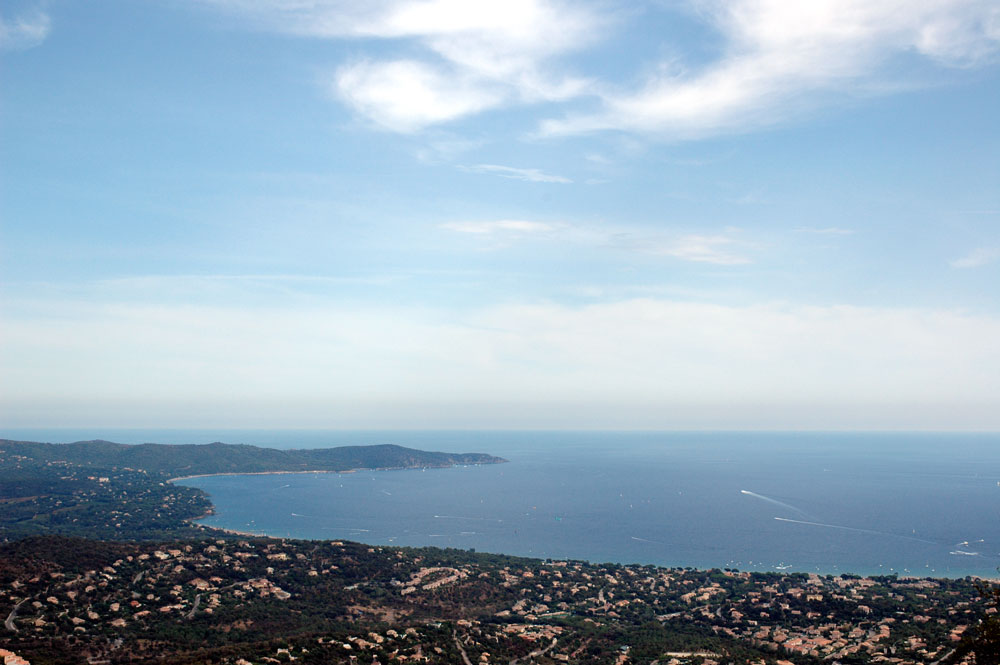
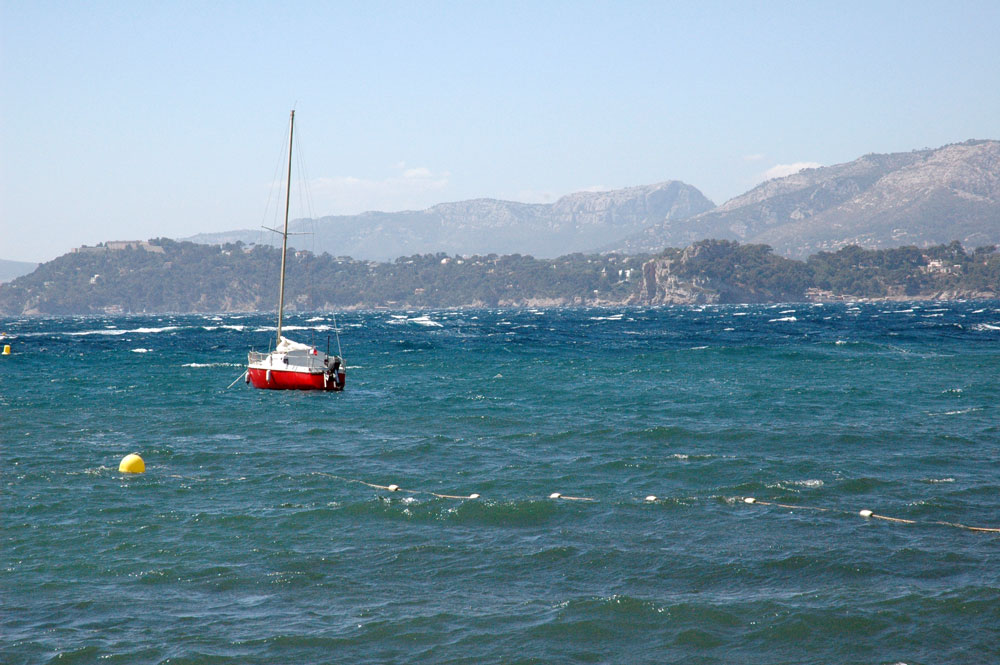
I think about that warm sea, holidays for so many, home to me, the view up the hill behind my sister’s home, the sailing with my brother, and I think about the people, portrayed as statistics because when far away from our own shores, we can’t relate to them, they are effectively numbers that need housing, feeding, jobs, land.

30 times more migrants across the sea this year than last year.
What next? What can we do?

We can’t help the whole world can we?

ViewsMed

But my ancestors,
they were not numbers.
Nobody’s ancestors are numbers.

So I can’t help but feel sick about the whole migrants in the Med situation. My great-grandparents weren’t escaping a war, it was a case of economics. They were hungry. A country across the sea offered a better life, they took their chances. As millions have for centuries, across oceans, deserts and mountains.

Irish, Scots, English, Welsh, Spanish, French, the list is endless.

As sure as the waves on the shore come and go, so do people.

Off my great-grandparents went on a fishing boat, not sure where they would land, no idea what their tomorrow would bring. The winds and the currents determined where they and many more families landed, and settled. No trafficker heading for a specific spot, at enormous cost to the desperate. I have not researched my family’s history in great detail, their tomorrow, my past. But these migrants catapulted into my mind the very little I do know about my own history. Little snippets deeply buried. Painful past families do not dwell on.

Except when history books paint a different story. Out comes the past, shouted in anger in a free country, whispered with no witness elsewhere.

My ancestors’ new life brought land, something in short supply on a small island. They farmed the virgin land, created a small vineyard, had a few animals, a close family and they employed local people to farm the land; farming for them, with them, depending how you want to portray it, those little words that make all the difference to English meaning.

With.
For.

But that land.
Who did it belong to?

Politicians told my family it was theirs. Thing is, if you get offered a chance to a better life, and you’re seriously down in the dumps, you’ll believe the promises won’t you?
I would.

Something new across the sea; hope.

SailBoatMed

Then, some seventy years later, the president of the land came along in the main city and spoke to all who had gathered. It felt like the whole city was out, and the villages around had come to see him. On that balcony. As statesmen do, loud and clear, he addressed a large crowd who were worried for their livelihood; and most importantly, their life. I imagine his arms stretched open in front of him, reaching out to the people, voice commanding:

“I understand you”.

Said the big man. Big cheers from the crowd. Hope renewed. Oh yes, the man could talk to people. He’s got it, they thought. My parents barely in their twenties listening in hope. They applauded. He understands us. He’ll look after us.

Four years later, they were summoned to leave the land. After a civil war.

Not that the politicians ever called it a war. Oh no. It was ‘the events’. Events that killed my grandfather. Not the son of the ones that came on that Spanish boat. No, these expats had come on a French boat. And he was married to a woman whose family had come on a boat all the way from Malta.

So when I start talking about politics or the unfairness of the system, and I sound like I’m shouting, or I look like a mad woman possessed by some kind of way-out-there passionate ideal, when I get agitated, or I am perceived as rude, or preaching…

I am sorry.

Tis my Mediterranean blood. I can’t change that. It boils inside, and sometimes it boils over. Not with weapons. I’m civilised. And I’m a woman. And I’ve heard the stories of that war. Like any war, the family stories are never stories you want to dwell on. It’s just that I just boil over with words when I see a pattern of history. Said, or written.

Or I keep very quiet, and bite my lip. My soft lower lip.

But who cares about my personal history?
It’s just a story. It’s just what makes me who I am. Just like you.

I find every history interesting, it helps me understand the person, not judge the person, understand the person, or the nation, or the wars. Answer the why. Like a child that does not want to grow up.

Maman… Pourquoi…?

We all think what we think, and think how we think, because of our personal history.

Understanding the past best we can, to untangle the present, helps get a better idea of what is likely to happen tomorrow. Non?

I have not learnt English history with no deviation from the accepted norm, nor French history for that matter. De Gaulle made sure of that. What I learnt at school was quite a different story than what I heard at home, as far as this colossus of French history is concerned. And that made me question institutions from a very young age. Not with weapons or thoughts of anarchy. I was lucky. I am lucky, I have never lived in a country at war at home. I just have observations, the very rare stories from my grandmother, the even rarer hints from my mother, the rage from my father whose father and brother were killed in the back whilst ploughing the family’s field, and coming across stories from survivors and from governments.

Just thoughts, just words.

De Gaulle let my parents down. He made a statement that gave his people hope. And meant nothing. “I understand you”. Still, they had to leave their home behind, my grandmother had to live with her children for the rest of her life, gone was her home across the sea, my grandparents’ home, the memories in the attic I never had, off they went to mainland France.

Their country.

They were French in Algeria. That was the deal. Not that French people on the mainland saw it like that mind. Not welcome. Not one bit. Signs on shop windows making it quite clear that they could not enter. Each and every one million of them. All in one go. 1962. Quite a year in French history. Not that it was ever mentioned by my history teachers in the 70’s or 80’s you understand.

I was born on the mainland. Yet in France’s statistics, I am a Pied Noir descendent. Therefore a Pied Noir, a French ‘repat’ from Algeria (repatriated).

A forever outsider with Mediterranean blood in my veins.
And that’s absolutely fine by me.
My mixed blood makes me who I am, makes my ‘English’ children who they are.
There is nothing wrong with me, or them.

There is nothing wrong with any of us.
Whatever blood flows in our veins.
Wherever we happened to be born.

What’s the story of these migrants on the Med today?

I wonder what Bob Marley would say?

Black Friday: 51st State?

“Have you heard of Black Friday?” I asked my teenager son.

“No. Is it to do with Black people” he replied.

“No, it’s to do with Thanksgiving and people queuing the night before hoping to get a TV half price”

“Sounds like a good idea” he concluded.

Which got me thinking. We all love a bargain. And got me worried. Yes, my explanation was flippant. But when I receive more and more emails every year from British companies telling me to buy, buy, buy because it’s Black Friday, it makes me wonder where it will end up.

A young woman was interviewed on the radio this morning. She’d already done her Christmas shopping so she wasn’t too happy about this new Bargain Day. She’s wasted money as far as she is concerned.

Is it such a good idea to let Black Friday enter our culture, as it has the US; is that really a good thing for this country in the long run? Billions of dollars are spent on that day. So yes, it’s good for business, mainly big businesses that have followed Wal-mart and Amazon.
Is that Amazon UK or Amazon US?

I know it’s all to do with consumerism; and band wagon. Yes, the UK increasingly becoming the 51st State. I don’t know how you feel about that. I’m French, so it’s no skin off my cultural nose but that worries me more than Poles taking our jobs, in the long run. Yes our jobs, I might be French but my kids are half British. And yes us French have a chip on our shoulder about America. But as a foreigner living in this country for almost 30 years now, I can’t help but notice that we follow the American elections one full year before Americans get to vote, and some of our political parties have employed Americans for their 2015 campaign; we listen to the American Secretary of State on matters of European concerns, like Ukraine, before we get to hear from the British government; even worse, Halloween gets bigger every year, or is just me thinking that?

The UK is unwilling to choose between being European or being America’s older cousin and best friend. Maybe the UK should not have to choose in our globalised world. Indeed most political parties in the UK are rather keen to sing the praises of an agreement that will make the US and Europe one big happy trading family. Not that they know any details (it is being discussed by the European Commission behind closed doors, as it is a trade agreement; and you can’t give away trade secrets). Rest assured, we are told it is a good idea. TTIP. (Don’t worry, it will go to the European Parliament to be voted on by our MEP’s. If you voted for a purple one, shame, they probably won’t turn up but that’s ok, they think it’s a good idea, I’ve asked all our MEP’s).

But I digress, that’s another subject altogether. Well, two actually; TTIP and Purple Politics.

So back to Black Friday. Where did it come from? Philadelphia’s police, early 60’s. Seems like a pretty bad start. Why did they call it that? Because they were overwhelmed by the number of shoppers. So here is a day that is so overwhelming that we need police officers to make sure people don’t harm each other in a stampede, shove each other hard enough to make sure they get there first. I mean we’re not the States, so hopefully we won’t get to the stage where armed shoppers, knackered to have spent the night queuing outside, cold from being unable to move to make sure they are first in the queue, hyper at the thought of the bargain of the century lose total sense of right and wrong and shoot an employee. But we can do stampede, and there’s been plenty of those in the States. One with fatal consequences where people just ignored a dead shop assistant crushed in the madness.

How does it get there?

Because like many things that start like a good idea, when we let them escalate without questioning them, they can tip over to the dark side. So next year, that young woman on the radio may well wait until she spends her hard earned cash. I hope she is safe when she joins the queues.

We are in a huge economic crisis. The bubble burst when the banking system convinced too many people who could not afford to buy a house that they should buy a house with a special mortgage; and then they lost their house. The people of course, they lost their home; not the banks, they kept the bricks and got saved by the taxpayers etc etc, we all know the story, it’s not history in books that can be amended to suit, we are living it. Are we out of that mess?

And here we go again. I bet you Black Friday is here to stay; for a while. It sure will help the big retailers.

Today, Black Friday 2014 the British Police weren’t too pleased to have to deal with overwhelmed supermarkets. Well, I can’t blame the Police, supermarkets are happy to take the cash but didn’t think of spending some of it on enough private security to ensure that staff and shoppers are safe.

What next, Thanksgiving in Dorchester to boost turkey sales in November?

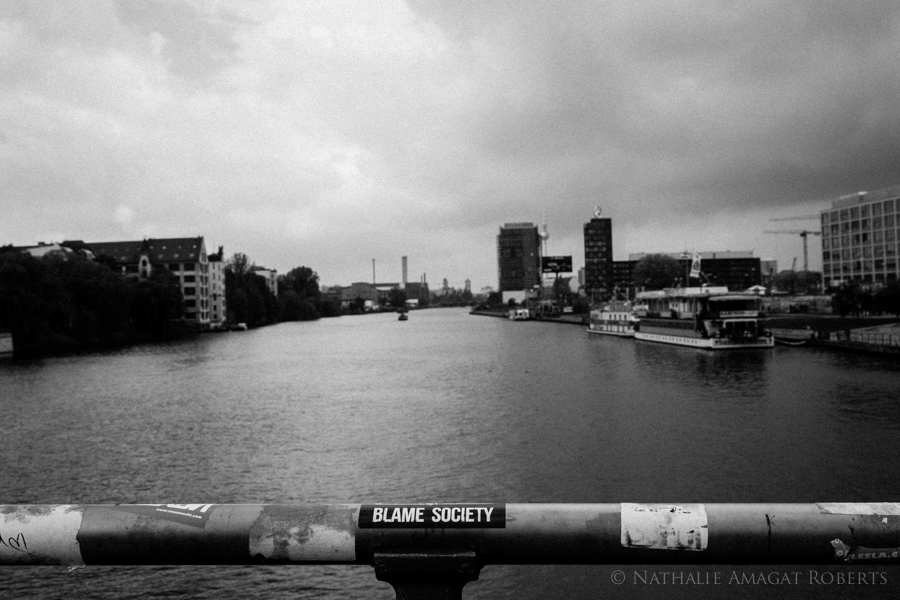
Berlin. Blame society?

natamagat-0242

Berlin is a gritty black and white city that throws bright colours at you when you least expect it. It shouts at you from street corners.

How  long is now
“How long is now?”

“Occupy everything”

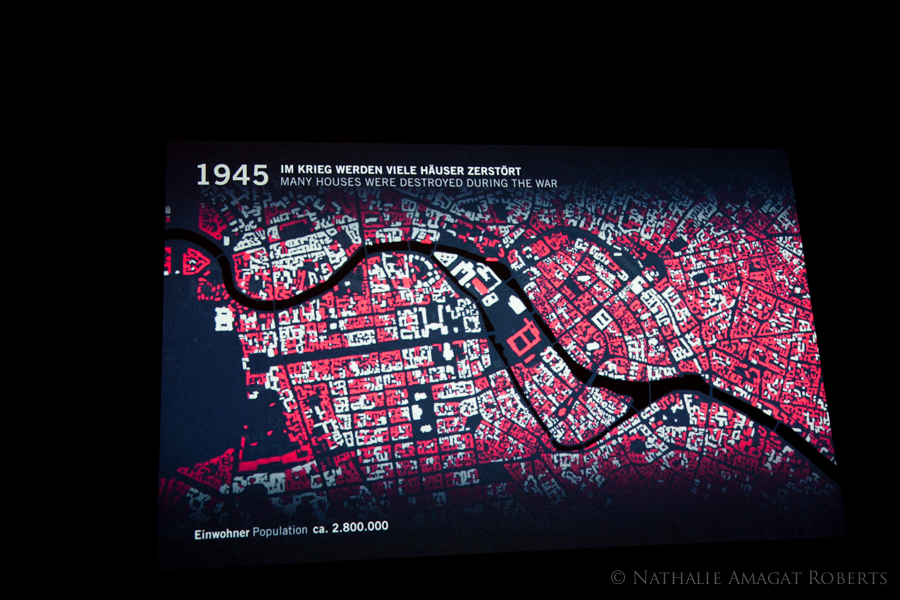
It’s not pretty but it is a visual feast. Street art flows in its veins. History stares at you. Endless gaping holes between buildings dares you to look away. Europe’s recent history, those never forgotten school lessons of recent wars are being challenged.

It was our bombs that created piles of rubble, our guns that left the scars we see in the buildings, and the ones we do not see in Germans’ minds.

Lest we forget.

natamagat-0099

This is 2014, 100 years after Franz Ferdinand, not the musicians although Berlin is music mad, but the Archduke. You know the one, they keep talking about him.

The start of that war to end all wars.
Oh and Sophie too, the wife, a forgotten name like millions of others.
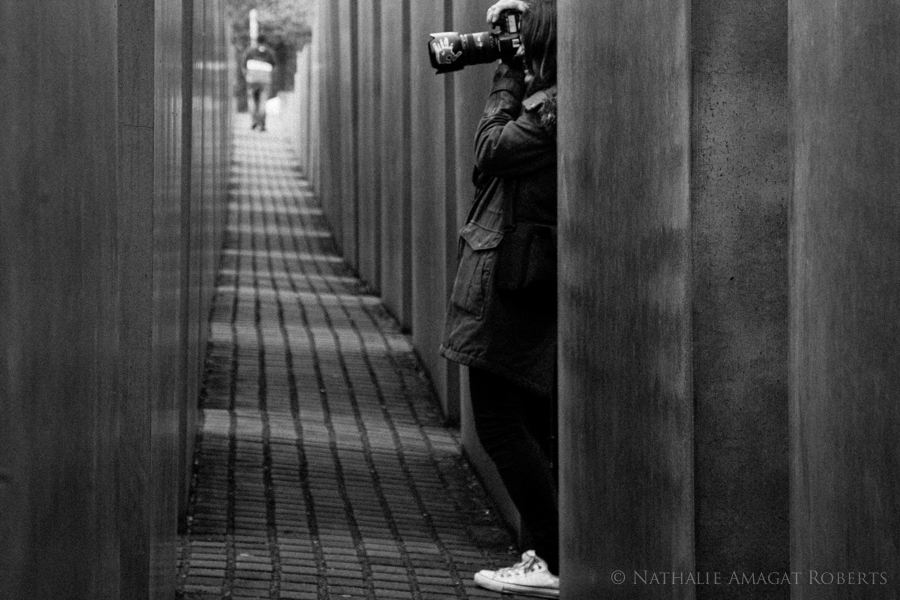
It may be the following war that has stuck in most people’s conciousness, remembered in blocks of concrete near the Brandenburg Gate, a maze for children to play in, as children should always be able to do.
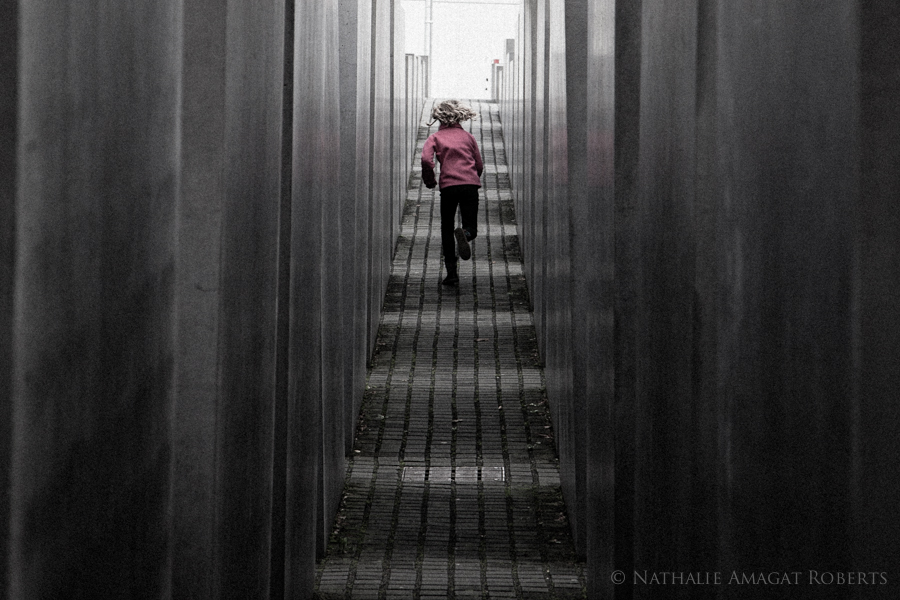
Jewish Memorial Berlin, children should always play

I was born 50 years ago.
25 years ago the Berlin wall came down.
I don’t like numbers but I like this series.
100, 50, 25, a perfect year to visit Berlin.

The most memorable birthday present from artist photographer and sister in law Lou, two friends and their cameras in search of inspiration.
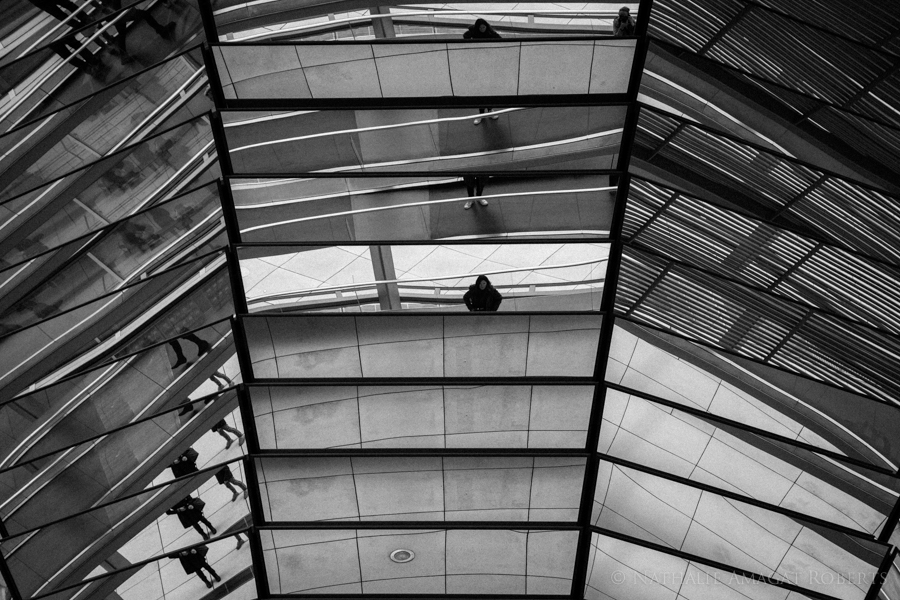
natamagat-0307

What would we find, what would inspire us in the Berlin of now, where the war is remembered in vertical and horizontal lines, with all shades of grey?

natamagat-0341

Where East and West no longer have a wall to represent divide?
You can’t visit Berlin and ignore politics.

“What side of The Wall are we on?”
Asked an Indian woman standing on the river side.
We’re standing on the West Side.
“So which side did people want to escape?”.
East Side, the other side.
“Oh. thank you very much”
She smiled an absent smile, her eyes deep in thought and walked on along the wall, as if peering on the other side. I wonder what the woman’s history is made of.

Why each person wants to see the wall.
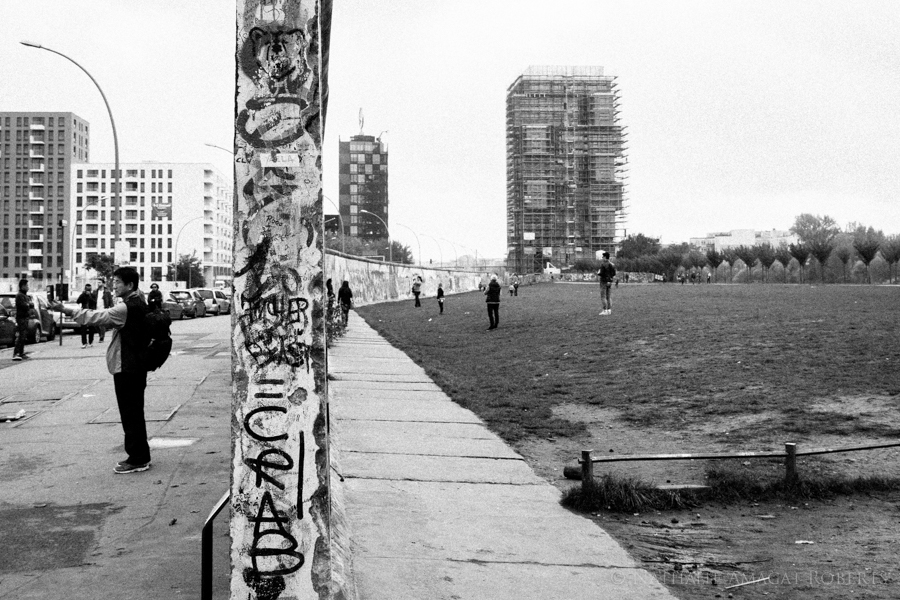
natamagat-0134

How does a city move on after almost constant war of some kind for near enough a century? Cranes are omnipresent, big L shapes turned on their head, moving metal lines in the skyline, scars of renewal on the horizon. Regeneration is everywhere and everything seems a fair canvas for street art. Graffitis are equally at home on derelict buildings as on new blocks of flats in what used to be East Berlin. German words I wish I could understand here and there on blocks of concrete.
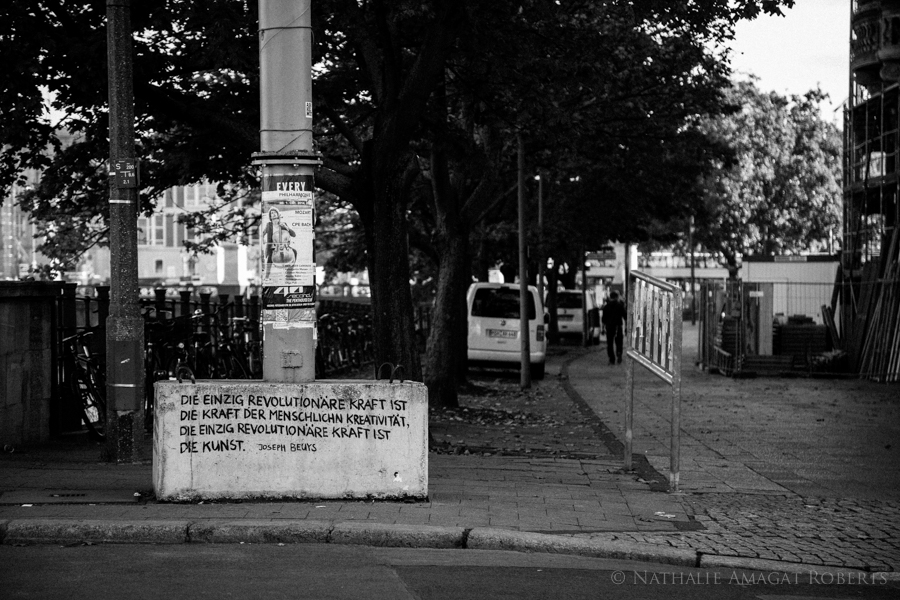
natamagat-9981

Revoluzionäre.
Kreativität.
What is the full story?

We know the story behind ‘The Kiss’ on The Wall.
You know, Brejnev and Honecker.

It was painted (twice) by Russian street artist Dmitri Vrubel. Less known is that the original image is a black and white photograph from French photographer Régis Bossu taken in 1979 during the 30th anniversary celebrations of the Democratic German Republic.
A moment in time perfectly caught on film, faces skilfully painted on a wall, a free gift of visual stimulation that questions, the dexterity of street artists and photojournalists offered in one fell sweep. Cooperation between a Westerner and an Easterner.

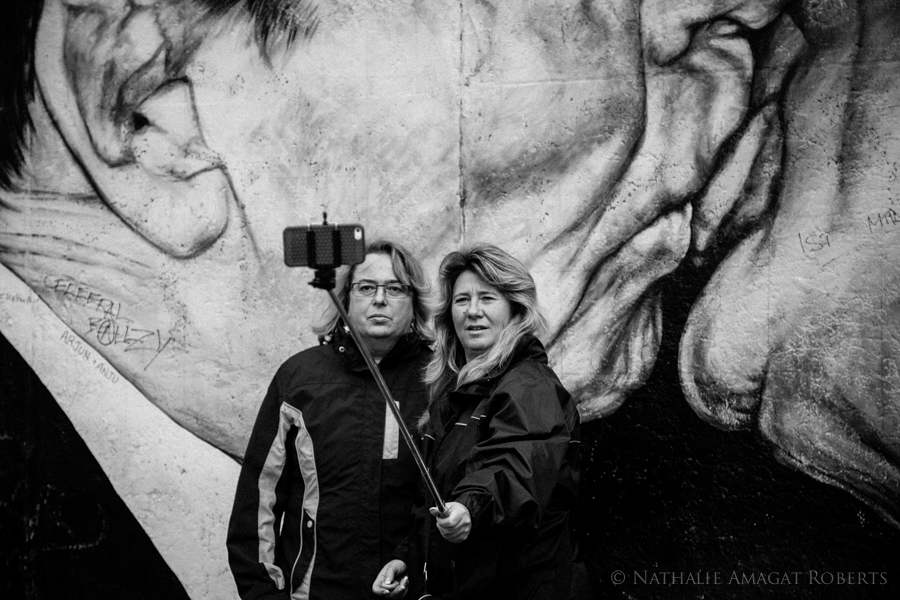
How ironic that it was being captured via a red phone at the end of a contraption made specifically for selfies. We looked on, with slight disbelief.

Another two women visiting Berlin, also recording time and place.

Each to their own, it’s a free world.

natamagat-0222

Memories can be wide angle or macro,

portraits of locals

or,

in 2014, selfies.

natamagat-0221

Images keep popping up.

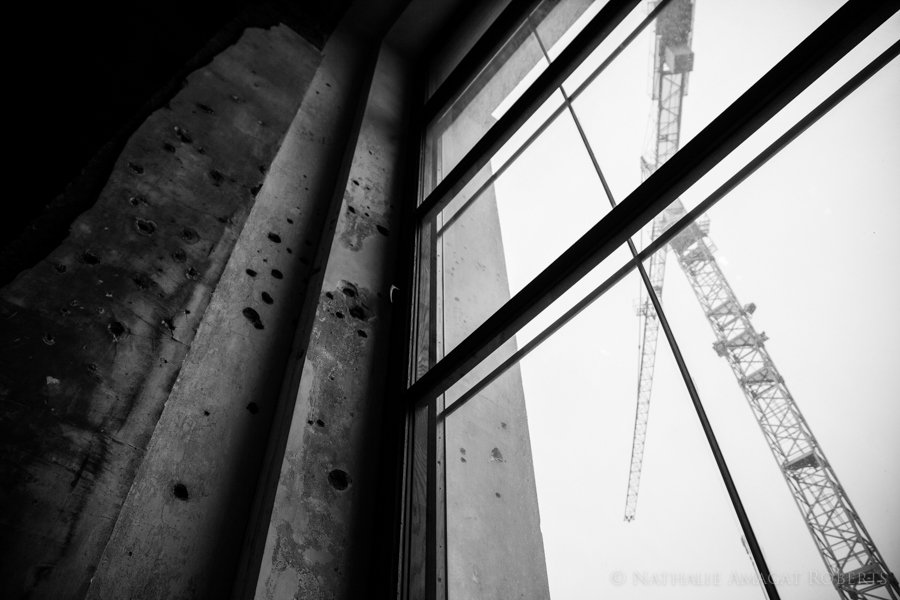
Columns with dark bullet holes at the Neue Museum in the foreground are next door to a crane seen through a tall window against a white winter sky.

A perfect frame in my head, past and present in one shot.
natamagat-0056

More images still are handed on a plate by street artists.

A small cut out of Dali is stuck under a bridge, a painting of the Queen (the British one) is hidden by colourful deckchairs stacked against a wall, waiting for a Berliner to take a rest from the hustle of the city in Monbijou park.

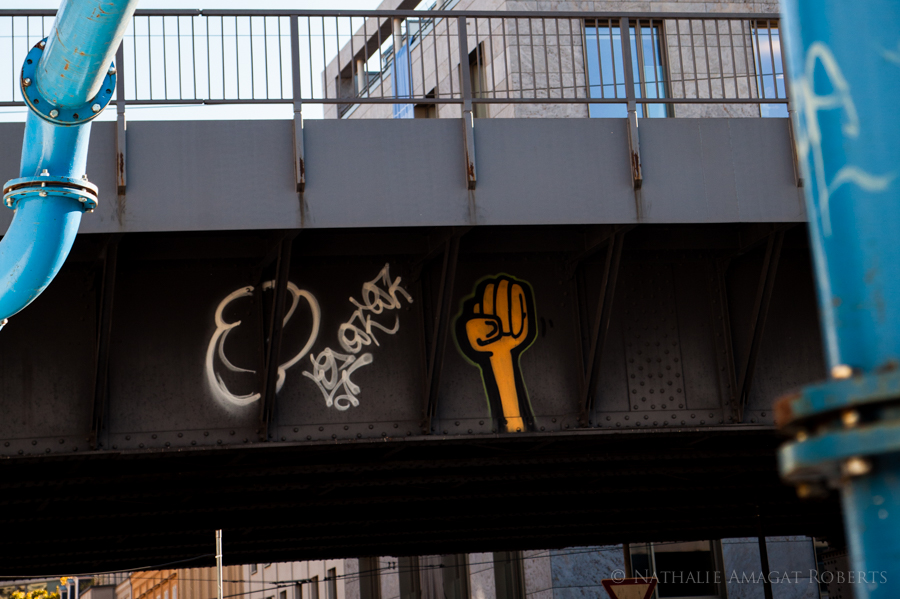
Yellow fists appear in improbable places, at the top of tall new buildings that can be seen from the U-Bahn, under bridges, as many up yours from East German street artist Matthias Wermke (Kripoe). A touch of anarchy in a city that only 26 years ago was half an occupied island in a Communist country, half a capital city of a Democratic Republic. What do you expect?
natamagat-9975

And now it is one, the capital of one of the richest country in the world.

In time, will Berlin’s history, our current European history, disappear forever to remain only in museums and galleries with Greek columns and concrete structures for parents to take their children and learn from the past?

natamagat-0006

If the atrocities that Hitler imposed on German artists and homosexuals -among others more widely remembered- are the back bone of how I see this city in 2014, the mind boggling divide imposed by the Allies after the war is the flesh that paints the Berlin that I feel.

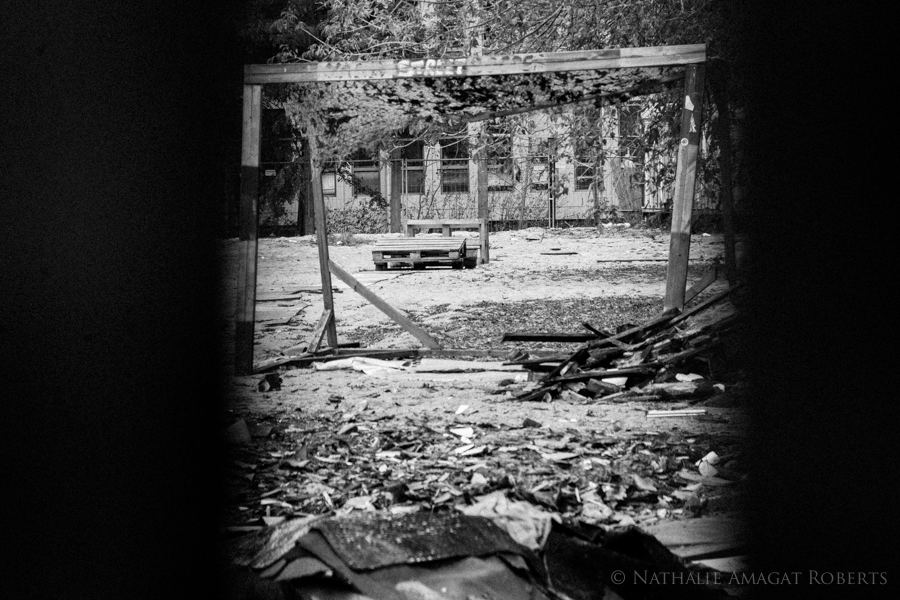
When The Wall fell in 1989, artists flocked to East Berlin, occupying buildings that East Germany had ignored since 1945. Imagine 44 years of neglect, buildings gashed open, from humble homes to grand residences. Imagine being an artist at that time.
natamagat-0135

If experimentation was your muse and creativity rather than money was your driver, the possibilities were endless. Imagine being an artist now and living in Berlin, or visiting Berlin. It is visually stimulating, it is constantly changing, it still has areas where rent is cheap, it is forever reinventing itself. Kreuzberg and Schöneberg are the new go to places for creatives that think Mitte has moved on and sold to the tourists. Maybe. It’s still incredibly cheaper than London or Paris.

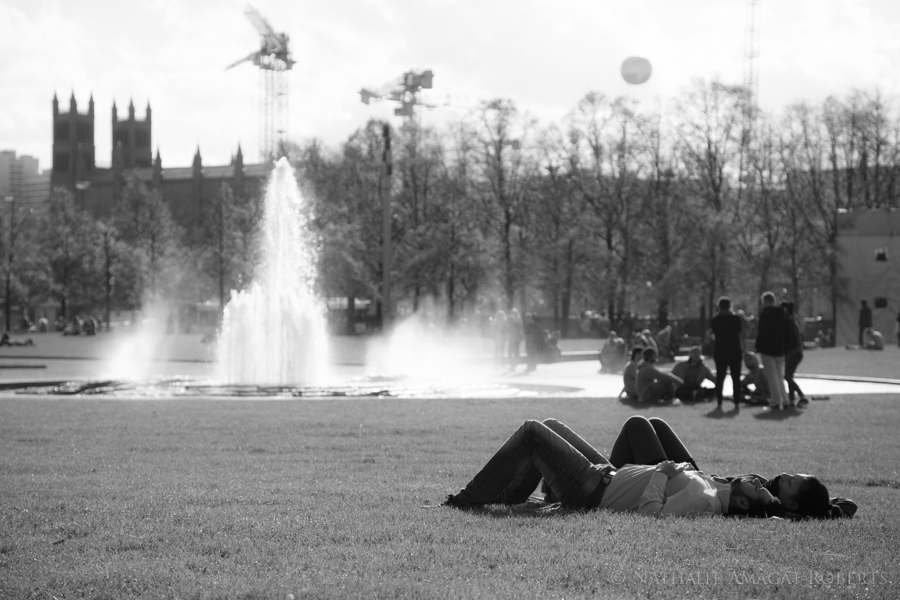
Berlin is fighting to keep the past alive and striving for a better future.
natamagat-0005

Whatever that may mean to a Berliner.
Whoever the real Berliners are.

Mitte is a place tourists head to for a slice of what used to be East Berlin. In 1989 artists headed East the minute they heard The Wall had fallen. They squatted empty buildings, made homes out of nothing, created art out of everything including Russian tanks and missiles, used the streets as perfect backdrops to extravagant live performances.

A new era was starting.

Tacheles on Oranienburger Strasse was originally built in 1909, a huge extravagant shopping complex in the Jewish quarter.
Eighty years later it was taken over by artists with much history in between.
In September 2014 Tacheles was sold for 150 million euros to Perella Weinberg Partners, a New York-based asset management company.

What happened in between?
When the original shopping complex went bankrupt, AEG took it over (and broadcasted the Berlin Olympics live in 1936, a first). It served as a central office for the SS, a prison for the Nazis, French prisoners hoarded in the attic. Most of it got bombed, Russian soldiers used the statues for target practice and tore down large chunks of what was left in the 1980’s. When artists took over the building in February 1990 they quickly founded an association and succeeded in getting Tacheles protected by the Historic Buildings Authority. The ruined statues are still there, for now.

It seems to matter not it was listed, 25,000 square-metres of apartments, shops and hotel rooms will follow.

Tacheles is no longer.

natamagat-0388

The other side of the gentrification coin.

A city divided still. Restaurants open up in courtyards and brand new hotels offer luxury at a price London could not even dream of, for now. Friedrichstrasse has a mixture of cheap eateries where workers lunch for around a fiver and upmarket restaurants where you won’t get a table on a Friday night unless you have booked.

You’d think posh Berlin eateries are the same as anywhere else. Not quite.

For a start, many restaurants only take cash.

Weird in our card and credit Western society huh?

Take The Pantry, in Mitte. Big art pieces on the walls, huge leather sofas, Asian European fusion cuisine that sounds pompous but is spot on, fun and fine dining in equal measures, impeccable service most restaurants could learn from, it is a place you sink in and don’t want to leave.
As I went to get more euros from the cash point, the waiter explained to my friend:
“The banks did not want to lend to us when we set The Pantry up. So when they asked for 8% commission we said F off”.
Right on.
Cash is fine.
“Oh no, I am so sorry your friend went to get cash, we could have given you a bill and you could have done a transfer”.

Trust people and fuck the banks.
Pardon my French, says the French woman, it was a German waiter that said it, in English, to my half Dutch British friend.
Europe in 2014.
Wunderbar.
Wonderland.

natamagat-0139

We happened to visit Berlin during European Month of Photography, not planned, just lucky. With 150 exhibition spaces we were never going to see everything in one visit. So we scratched the surface and headed for Mitte and its concentration of galleries.

Walking along Tucholskystrasse Andy Warhol stared at us from behind his shades and the back wall of Galerie Hiltawsky. Pin sharp white hair up in the air and half of the face pointedly lit from the right, only the grey top of the rim of the glasses a thin line on the left. Greg Norman’s blacks drew me in like deep holes of emptiness, his whites made me stand back and open my eyes wider. Stunning portraits.

It was interesting to check the prices, from 3,000 euros for limited editions of 25, which having just popped into a snotty gallery where five abstract prints that woke nothing in my heart or stomach were on sale for 25,000 euros put things in perspective.
natamagat-0041

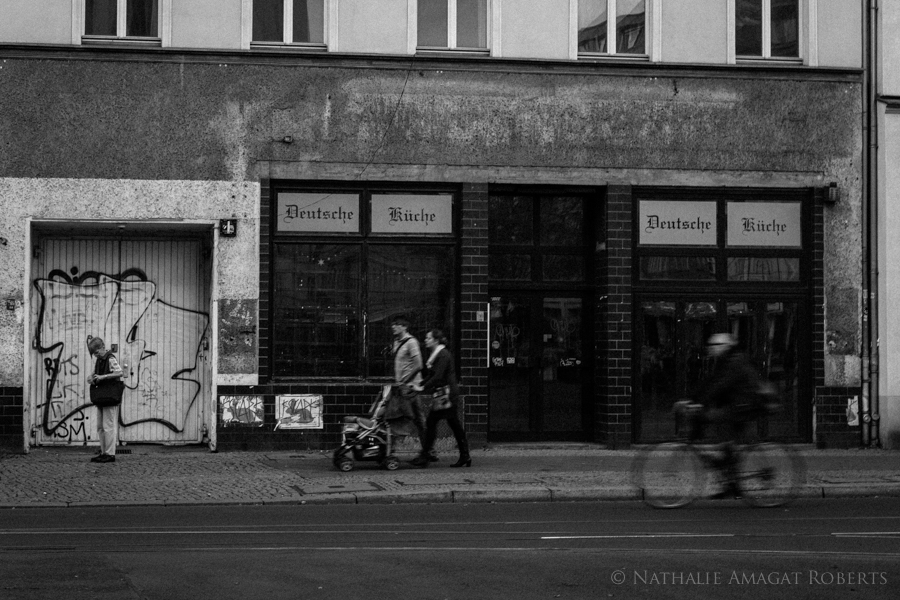
Mitte, 2014.

My favourite show was Berlin Wonderland: Wild Years Revisited, 1990-1996. Just outside, there were sleek galleries and inviting courtyard cafes. Inside was a room filled with gorgeous books published by Gestalten, beautiful and expensive designers’ objects, a long table and chairs where you could sit and read, a jug of fresh tap water with lemon slices a simple welcoming thought for the thirsty visitor.

At the back, the exhibition. Views of Mitte in the early years of reunification by artist photographers who lived in East Berlin at the time.

De Biel, Rauch, Recklinghause, Schilling, Schmundt, Trogish, Zöllner.

The images were not polished, the shots not always pin sharp. They were so much more. They informed of a time of change, they questioned, they inspired. They were beautifully printed on Baryta paper, in limited editions of 30. Starting at 300 euros for a 30×40 cm print, they portrayed a brief if intense history that shouldn’t be forgotten yet so few of us know anything about. Short lived movements can have a big impact in society. Bauhaus only lasted 14 years yet its influence on architecture, design and typography was substantial.

natamagat-0265

In Mitte, artists told me their story via black and white photography of a time that could not last.
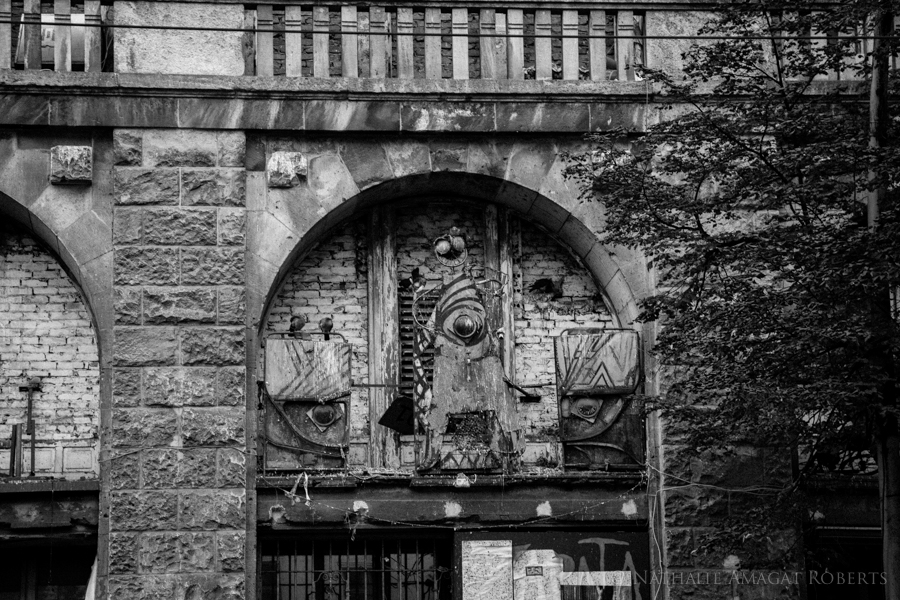
This is where I learnt about the squatters, discovered Tacheles before stumbling upon the building on my way back home.
I’ll never know inside that alternative art space but at least I’ve captured the outside before it disappears forever.
natamagat-0389

Photographer friends,
Berlin is waiting for you now,
how will you see Marlene’s city?

natamagat-0017

natamagat-0037

natamagat-0249

natamagat-0272

natamagat-0317

natamagat-0242

Bibliography:
Berlin Wonderland: Wild years revisited, bobs airport, published by Gestalten
http://www.abandonedberlin.com/2010/04/tacheles-how-long-is-now.html
http://www.bbc.co.uk/news/world-europe-19473806
http://www.bloomberg.com/news/2014-09-25/perella-weinberg-buys-former-squatters-site-in-berlin.html

Open the door and let me fly

“Are you a Communist?” 

The man stared at me as if trying to get through my eyes and dig into my mind, making sure no lie would come out of my mouth. The voice was deep, the words were spat out with disdain.  

Had I done something wrong? I was a little bit scared. I didn’t quite understand the question, or why he asked, I’d never been asked what my political views were by some stranger; what did it matter anyway? Who did he think I might be? A spy? 

We’d talked politics at home, a bit, and at school a bit more, but to me it was all bollocks anyway and my political interests were more comedian Coluche and singer Balavoine who attacked the political elite on television and were far more interesting than the same old suited men who made very little sense. Artists were the ones that talked straight, questioning the politicians stuck in their own world, way away from what young people wanted, mainly peace. I sure wasn’t a member of any party, so to call me a Communist just struck me as a stupid question. 

All of seventeen, probably the equivalent of a thirteen or fourteen year old that I would know today, the furthest away from home I’d ever been, I had arrived in New York with a plane load of Swiss teenagers bound for a year away from home.

I’d chosen Canada and I was the only French fish in a sea of Swissness. All the Swiss passports were glanced at, quickly stamped and the Swiss kids got a nod and off they went in an orderly queue towards the open doors behind the custom officers. No questions asked. 

Meanwhile, this man was staring at my passport, and in turn at me, making a bit of a show of it all. I probably got very red in the face, annoying habit of mine, and opened my eyes wide, automatic habit of mine when faced with a challenging question, especially when somebody is being aggressive, which he was.   

“Well no. I’m not.” I paused. Then asked: “Why?” A bit unwise I grant you, but then at that age, why should I have been wise? Why indeed, still my favourite question, yet so often leads to such unsatisfactory answers. 

“Because you have a Communist president” he replied, his face a cross between angry and condescending. 

How weird, I thought. It was 1982. France had decided to swing to the left with President Mitterand the year before. With just over 51%, he was the first Socialist president since 1959 but I had no idea that it may be significant outside of my country. With my little interest in politics and the old people who ran the country, I knew that my president was a Socialist. Marchais was the Communist one, and he’d lost in the first round. What was this man on about? 

“No. President Mitterand is Socialist, not Communist, and I am not a Communist”. He was still staring at me, doubting my words, obviously, I realise now. I could feel his hostility in my bones and I had no idea why.  

He handed my passport back. “Socialists, Communists, French…” he mumbled as if spitting, firing insults like bullets stuck together. His colleague was smiling at the last Swiss kid, welcomed in, unquestioned. I took my passport, thanked him, I think, automatic reaction, and moved on to join the group of young people I had just met hours before at Geneva airport; they, all smile and excitement to finally have made it to the United States of America after a year of interviews, meetings, bonding exercises and doubts; me, a little bit shaken. 

I never did get a ‘Welcome to the United States of America’ but then again, I was heading for Canada. I sometimes wonder, had I spent a year in the USA instead, would my views of that country be different now? I was ‘saved’ from living with a Canadian Mormon family by a Canadian Catholic family because of religious values, I was questioned by that American Customs officers because of orders from above, I was bullied by English speaking Canadian kids on the yellow school bus for weeks because I had a French accent so they assumed I was French Québécoise. 

I was part of an international exchange charity whose aim is to promote peace and understanding between countries, AFS, who celebrated 100 years in 2014. And do you know what? It was one of the very best gifts my parents ever gave me. Open the door and let me fly. Go and discover the world. It’s a bit scary at times, it’s a challenge of course, but with hindsight and more years in yet another country under my belt, I’ve realised that we all have prejudices. Travelling taught me to try and not judge, we’re all trying to do our best with the beliefs we were brought up with. I don’t always succeed, I still struggle with narrow minded Americans, but it’s a big country, they’re not all bad, neither are all French perfect, or Communists. 

Quelle surprise!