I have joined a couple of writers, Maddie Grigg and Sophia Moseley and together we are The Lady Shed, a weekly blog where we discuss current affairs, local matters, and … Continue reading Rampisham Down, and Lady Shed


I have joined a couple of writers, Maddie Grigg and Sophia Moseley and together we are The Lady Shed, a weekly blog where we discuss current affairs, local matters, and … Continue reading Rampisham Down, and Lady Shed
First posted on The Lady Shed 9/1/15
As fate would have it, for my turn on the Lady Shed this week I wanted to talk about satire, comedians and politics but in the light of the events in Paris, Russell Brand is out. My friends will know that I have been going on about my visceral fears of France’s fate in the last year, my country. Sleep has been difficult since 7/1.
We must beware to point the finger at one religion as most commentators have done, it is far more complicated than that, this attack did not happen in a vacuum, it happened within world events, it affects us all. To continue to simply point the finger at Islam extremism will only lead to more extremists, more hatred, more divides and ultimately, as we all fear, more blood.
We do not have freedom of speech nor do we have press freedom. France’s laws prevent its citizens from writing anything racist, xenophobe and, unlike this country anti-Semite. This is as it should be. It must be noted however that in France anti-Semitism and anti-Zionism are seen as one, despite being two different things; they have become a single toxic subject that few will dare talk about for fear of misunderstanding, fear of offending and fear of reprisals. This is the most difficult post I have written, but France is my country, I cannot keep silent.
As the BBC has rules about not having any depiction of the Prophet for fear of offending, the French media does not discuss Anti-Zionism for fear of opening up old wounds that are deeply anchored in the French psyche; genocide a common guilt that Catholics have no idea how to deal with. We’re ill equipped for dealing with guilt when born in a Catholic society. Hell in the eternal life looms over our head to the point of silencing us in our short life on earth, as it has on many subjects over the centuries.
Zionism is not a religion, it is not a race, it is political. Sweeping difficult subjects under carpets does not mean they go away. Prohibition has consequences we have seen before. When France is not permitted to discuss Zionism yet discusses Islam extremism at length, this is not a balanced discussion of France’s other cultures within the republic. It is not about race or religion, it is about culture and the way we are brought up at home within a country where all are equal. We cannot have Fraternité nor Liberté without Egalité.
Anybody who is surprised about armed men taking the law into their own hands has not been following France’s events. French people are not surprised. Charlie Hebdo’s attack is in part due to the fact that very few newspapers and magazines will go where Charlie Hebdo went. I wanted to see newspapers around the world who said they were shocked about the events as it attacked freedom of press to publish some of the magazines’ cartoons on their front page. Not just the ones denouncing Islam extremists as many blogs have done adding fuel to the fire of misunderstanding what Charlie Hebdo stood for, but also the ones about Catholics, Jews, the Far Right, and the narrow minded white French man, Frenchie Joe Blogg. Oh and the English, my favourite subject, naturellement.

We need humour to survive. Humour is like anything else, what I like to eat is not what you like to eat. What I am allowed to eat is not the same as what other religions can eat. Sarcasm may be the lowest form of wit, I love it. No apology. Satire has long existed. Humour is part of our evolving civilisation. Court jesters were the only ones who could tell the all powerful King what the peasants thought and not be killed when he delivered the message; provided the King was fair and did not kill his subjects when he did not like what he heard, just because he could.
Satiric cartoons have long been able to depict in one single image an event, a mood, a wrong doing by the all powerful, kings, emperors, popes and again, even common people like me and you. We need this art more than ever. In our world where if this post goes over 800 words you won’t read it, we need images to wake us up to the realities that we keep shying away from. If art makes us smile or cringe but makes us think, it is needed. We want to get on with our lives, protect our children. We want to give our children a better world for tomorrow but are absolutely and totally hopeless at dealing with the bigger issues that are at the root of 7/1.
Since 9/11 the West has finally realised that a part of the world population hates us. Deep down we know why. We live in a world where a mainly Christian democracy thinks they have the right to tell the rest of the world what to do. Along with its allies, who are forever reminded that they were helped against the Nazis, and yes especially the cheese eating surrender monkey French, they (we) attack Muslim countries to prevent a war on terror and, because we are not infallible, we get it wrong. Are we helping? Are we attacking or are we defending? Are we defending ourselves against terrorists?
The largest democracy in the world uses drones against these countries whilst backing and funding a Jewish state that was given to Zionists by WWII winners. A war that started in Europe and took over the world once the Americans were attacked in Pearl Harbour gave its winners the right to draw a line in the sand in the Middle East, an appropriated land. Do we really wonder why the world is constantly at war? No we don’t. We know. But we are so deep in shit created by the past that we have no idea how to deal with the present to give our children a decent world in the future.
“Mummy, will we have a war” said my son when Ukraine kicked off.
Miss a heart beat.
We are already at war.
It is a world war.
Europeans and Americans helped start the Ukraine uprising, then pointed the finger at the Russians for their wrong doings because others’ wrong doings are always worse than ours. On 7/1 this international war came to the French capital with Russian AK47. Should we blame the Russians for selling arms?
It is all interlinked, we never really got out of the Cold War as the state of Europe today shows. When a French person says that a large majority of people in jail are Arabs, they’re called racist by news presenters who are petrified their show will turn into contentious subjects they’d rather not discuss at all. When we are labelled anti-Semite on one hand, racist on the other when we discuss the problems our country faces, with facts and figures, not emotion; when our police does not enter some parts of our cities where deprived disconnected French citizens feel they are not part of French society and rule a violent mini society within, where do we go next?
This is where we are. Are we Charlie? Charlie is the bloke in the pub that talks loudest, he is totally politically incorrect and many walk away from him. Charlie is not a fascist. He does not vote Le Pen or UKIP. He hates the Far Right and shouts it from the top of his voice to whoever will listen. And he doesn’t give a damn if you walk away offended. He speaks his mind. He takes the piss out of everybody, especially the Far Right voters who have forgotten than in the 1930’s, Germans never thought that Hitler would kill his own people if they were disabled, gay or stood up against his regime. Do we think we can’t go back to that? Did the Germans of 1930 think they would ever have to live what the ones who survived had to live?
In Dresden in 2015 some people think their problems are due to Islam, as more and more people do in many parts of Europe. Our problems are rooted in a history we cannot change and a diversity of population that keeps changing as it always has. The arms trade is doing fine. Yet for a minority of armed extremists there are billions of people who do not want war. Now more than ever we are able to stand together against more militarisation and against those newspapers and political parties that only bring more hate and division. We won’t solve the problems in one post, within one year or within one country. But together we can pressure our governments to lead us on the road of meaningful negotiations, and we can convince one person at a time that hate fuelling newspapers should not be shared so these media outlets who are dividing European citizens against each other within their own countries, let alone within Europe can lose readers, one by one. Non violent unarmed people are the majority.
If we lose hope and humour, we lose everything. Let’s have faith in human beings.

The cartoons on this post are by Charb one of twelve French citizens killed on 7 January 2015 by three French citizens armed with AK47.
Originally posted on The Lady Shed on 12/12/14
A Facebook friend shared a photo of a French man with a yellow triangle stuck on his chest. “Shame on you Marseille” she wrote.
So I read the caption, obviously:
“French homeless forced to wear ‘yellow triangles’”
What is wrong with France I wondered before I had time to think, brain blinded into alarm mode. Have they gone mad?
“The city of Marseille has been blasted for using Nazi-era tactics to identify its homeless population by issuing them with ID cards, adorned with a yellow…”
Well I bet, for crying out loud, what were they thinking?
A bit of research (in French, it helped) and the story appeared to be political poop-stirring. Once a city votes a far right councillor into office, as Marseille has, all sorts of poop will hit the fan; from stories that absolutely need to be reported to twisted facts taken out of context to create catchy headlines (and poop-loads of hits on a website).
And now in this country, as I feared prior to the European elections, main political parties have jumped on the immigration bandwagon, driven as we are by the media’s bottom line rather than balanced facts and figures. With a far right party driving the national train to the good-old-days of la-la-land stuck firmly in the long gone era of steam engines, I wonder: what is waiting for us at the next station?
Now, if you are concerned with the rise of UKIP in this country, you may think so long as we point out how dangerous the Far Right could become, never mind the tactics. Maybe, then again adding oil to the fire of xenophobia has consequences. When I commented on my friend’s Facebook that the original idea of that yellow triangle was to help, it was not an obligation nor supposed to be worn in full view, my friend was not having any of it. She’d seen the yellow triangle, and like me, understandably seen red. “Wake up and smell the coffee” said an outraged Facebook friend of hers.
There are images that blind us. A yellow triangle is one of them; rightly. There are stories that scare us. In an economic crisis, the fear of our child or grandchild losing their job to a lesser paid foreigner will shout loud and clear ‘Protect my child”. People who can’t find a decent job will understandably look to political parties that promise to offer answers. We need to blame someone for the ills of our overcrowded NHS and schools, worn out roads or zero hour contracts.
Nigel Farage on BBC Question time yesterday (11/12/14) explained that foreigners would exasperate these national problems with no explanation of how he would solve these exasperations. When an angry woman in the audience shouted against the rise of the far right, Mr Farage turned to Russell Brand – who had been told he should stand for election by another angry man in the studio – “Yes, you should stand for election. These are your voters. They’re lovely people”; imagine a half smile of contempt behind eyes that mean anything but the words being spoken. Man of the people indeed, maybe he should become a comedian, sarcasm at the ready.
Blaming foreigners turns to something like this “Maybe with Marseille’s collaboration during the war they learned all the wrong things?” was one of the comments on my friend’s Facebook post. Thump. Why don’t you just whack me in the face and kick me in the stomach? I thought. But did not write. These ‘articles’ and this constant blame game bring the worst out of us.
Ahead of an election year where dozens of communication specialists paid by political parties will look for stories to bash the opposition with; when more out of context quotes from politicians will create rivers of quick outraged articles that will leave the real issues unanswered, I can’t help but wonder quite how nasty it will become.
When I left France twenty seven years ago Monsieur Le Pen was beginning to change the face of French politics; and in its wake, France. Rather than build bridges that history had created and politicians had exasperated, canyons of hate are still being dug, forever wider. Here in the rural South West of England, a small minority were followed by a large proportion of voters in the last European elections. Two UKIP MEP’s sit at the European parliament representing the South West. That’s two out of six. I have a growing bitter taste of déja-vu in my mouth.

France is different, friends assure me. Yes it is, but like it or not we are joined at the hip by European history. I sure hope the Rosbifs will not go down the same route nationale as the Frogs. We can’t vote for celebs, MP’s is all we have. But Russell Brand has a point, the air smells of revolution.
I hope it does not have the bloody taste of the French Bastille of old nor have the smelly whiff of today’s French political landscape. Oh and like all Europeans in the UK, I can’t vote in the national elections. The fate of the UK political landscape is down to British and Commonwealth voters.
We’re in your hands.
“Have you heard of Black Friday?” I asked my teenager son.
“No. Is it to do with Black people” he replied.
“No, it’s to do with Thanksgiving and people queuing the night before hoping to get a TV half price”
“Sounds like a good idea” he concluded.
Which got me thinking. We all love a bargain. And got me worried. Yes, my explanation was flippant. But when I receive more and more emails every year from British companies telling me to buy, buy, buy because it’s Black Friday, it makes me wonder where it will end up.
A young woman was interviewed on the radio this morning. She’d already done her Christmas shopping so she wasn’t too happy about this new Bargain Day. She’s wasted money as far as she is concerned.
Is it such a good idea to let Black Friday enter our culture, as it has the US; is that really a good thing for this country in the long run? Billions of dollars are spent on that day. So yes, it’s good for business, mainly big businesses that have followed Wal-mart and Amazon.
Is that Amazon UK or Amazon US?
I know it’s all to do with consumerism; and band wagon. Yes, the UK increasingly becoming the 51st State. I don’t know how you feel about that. I’m French, so it’s no skin off my cultural nose but that worries me more than Poles taking our jobs, in the long run. Yes our jobs, I might be French but my kids are half British. And yes us French have a chip on our shoulder about America. But as a foreigner living in this country for almost 30 years now, I can’t help but notice that we follow the American elections one full year before Americans get to vote, and some of our political parties have employed Americans for their 2015 campaign; we listen to the American Secretary of State on matters of European concerns, like Ukraine, before we get to hear from the British government; even worse, Halloween gets bigger every year, or is just me thinking that?
The UK is unwilling to choose between being European or being America’s older cousin and best friend. Maybe the UK should not have to choose in our globalised world. Indeed most political parties in the UK are rather keen to sing the praises of an agreement that will make the US and Europe one big happy trading family. Not that they know any details (it is being discussed by the European Commission behind closed doors, as it is a trade agreement; and you can’t give away trade secrets). Rest assured, we are told it is a good idea. TTIP. (Don’t worry, it will go to the European Parliament to be voted on by our MEP’s. If you voted for a purple one, shame, they probably won’t turn up but that’s ok, they think it’s a good idea, I’ve asked all our MEP’s).
But I digress, that’s another subject altogether. Well, two actually; TTIP and Purple Politics.
So back to Black Friday. Where did it come from? Philadelphia’s police, early 60’s. Seems like a pretty bad start. Why did they call it that? Because they were overwhelmed by the number of shoppers. So here is a day that is so overwhelming that we need police officers to make sure people don’t harm each other in a stampede, shove each other hard enough to make sure they get there first. I mean we’re not the States, so hopefully we won’t get to the stage where armed shoppers, knackered to have spent the night queuing outside, cold from being unable to move to make sure they are first in the queue, hyper at the thought of the bargain of the century lose total sense of right and wrong and shoot an employee. But we can do stampede, and there’s been plenty of those in the States. One with fatal consequences where people just ignored a dead shop assistant crushed in the madness.
How does it get there?
Because like many things that start like a good idea, when we let them escalate without questioning them, they can tip over to the dark side. So next year, that young woman on the radio may well wait until she spends her hard earned cash. I hope she is safe when she joins the queues.
We are in a huge economic crisis. The bubble burst when the banking system convinced too many people who could not afford to buy a house that they should buy a house with a special mortgage; and then they lost their house. The people of course, they lost their home; not the banks, they kept the bricks and got saved by the taxpayers etc etc, we all know the story, it’s not history in books that can be amended to suit, we are living it. Are we out of that mess?
And here we go again. I bet you Black Friday is here to stay; for a while. It sure will help the big retailers.
Today, Black Friday 2014 the British Police weren’t too pleased to have to deal with overwhelmed supermarkets. Well, I can’t blame the Police, supermarkets are happy to take the cash but didn’t think of spending some of it on enough private security to ensure that staff and shoppers are safe.
What next, Thanksgiving in Dorchester to boost turkey sales in November?

Berlin is a gritty black and white city that throws bright colours at you when you least expect it. It shouts at you from street corners.

“How long is now?”
“Occupy everything”
It’s not pretty but it is a visual feast. Street art flows in its veins. History stares at you. Endless gaping holes between buildings dares you to look away. Europe’s recent history, those never forgotten school lessons of recent wars are being challenged.
It was our bombs that created piles of rubble, our guns that left the scars we see in the buildings, and the ones we do not see in Germans’ minds.
Lest we forget.
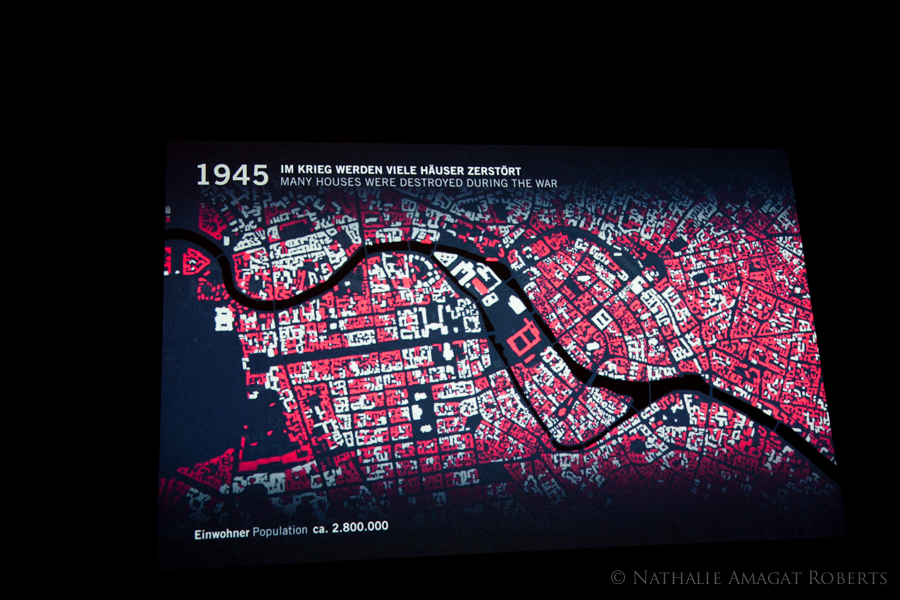
This is 2014, 100 years after Franz Ferdinand, not the musicians although Berlin is music mad, but the Archduke. You know the one, they keep talking about him.
The start of that war to end all wars.
Oh and Sophie too, the wife, a forgotten name like millions of others.
It may be the following war that has stuck in most people’s conciousness, remembered in blocks of concrete near the Brandenburg Gate, a maze for children to play in, as children should always be able to do.

I was born 50 years ago.
25 years ago the Berlin wall came down.
I don’t like numbers but I like this series.
100, 50, 25, a perfect year to visit Berlin.
The most memorable birthday present from artist photographer and sister in law Lou, two friends and their cameras in search of inspiration.

What would we find, what would inspire us in the Berlin of now, where the war is remembered in vertical and horizontal lines, with all shades of grey?
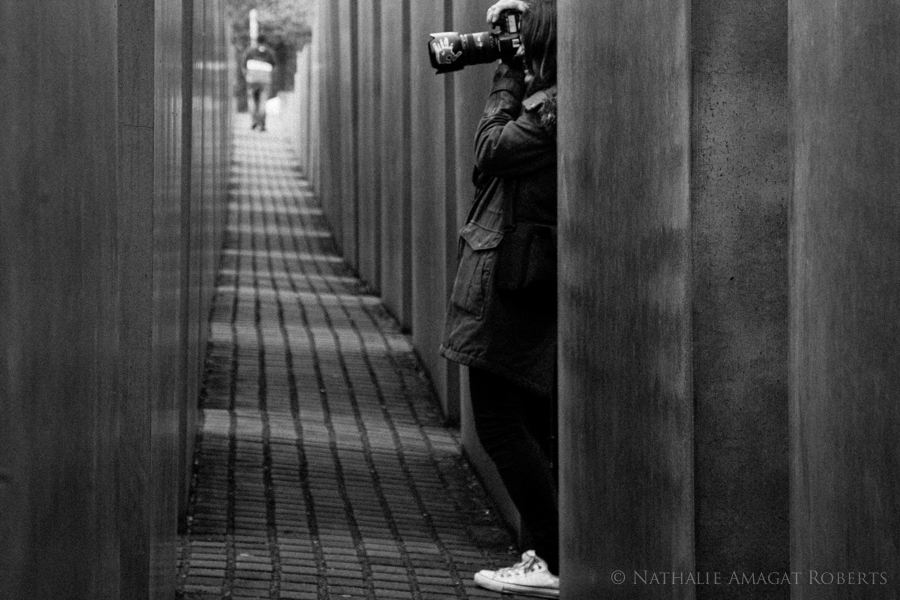
Where East and West no longer have a wall to represent divide?
You can’t visit Berlin and ignore politics.
“What side of The Wall are we on?”
Asked an Indian woman standing on the river side.
We’re standing on the West Side.
“So which side did people want to escape?”.
East Side, the other side.
“Oh. thank you very much”
She smiled an absent smile, her eyes deep in thought and walked on along the wall, as if peering on the other side. I wonder what the woman’s history is made of.
Why each person wants to see the wall.

How does a city move on after almost constant war of some kind for near enough a century? Cranes are omnipresent, big L shapes turned on their head, moving metal lines in the skyline, scars of renewal on the horizon. Regeneration is everywhere and everything seems a fair canvas for street art. Graffitis are equally at home on derelict buildings as on new blocks of flats in what used to be East Berlin. German words I wish I could understand here and there on blocks of concrete.
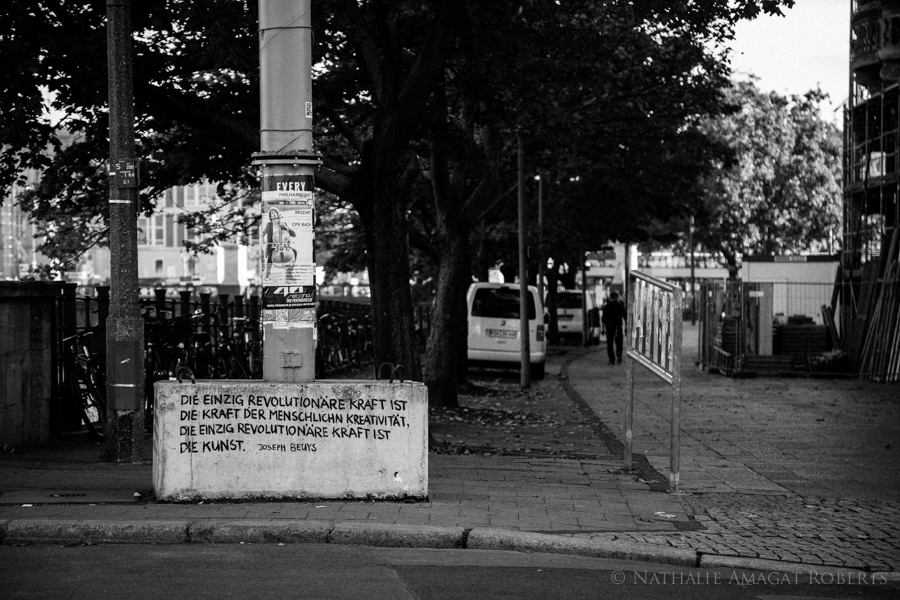
Revoluzionäre.
Kreativität.
What is the full story?
We know the story behind ‘The Kiss’ on The Wall.
You know, Brejnev and Honecker.
It was painted (twice) by Russian street artist Dmitri Vrubel. Less known is that the original image is a black and white photograph from French photographer Régis Bossu taken in 1979 during the 30th anniversary celebrations of the Democratic German Republic.
A moment in time perfectly caught on film, faces skilfully painted on a wall, a free gift of visual stimulation that questions, the dexterity of street artists and photojournalists offered in one fell sweep. Cooperation between a Westerner and an Easterner.
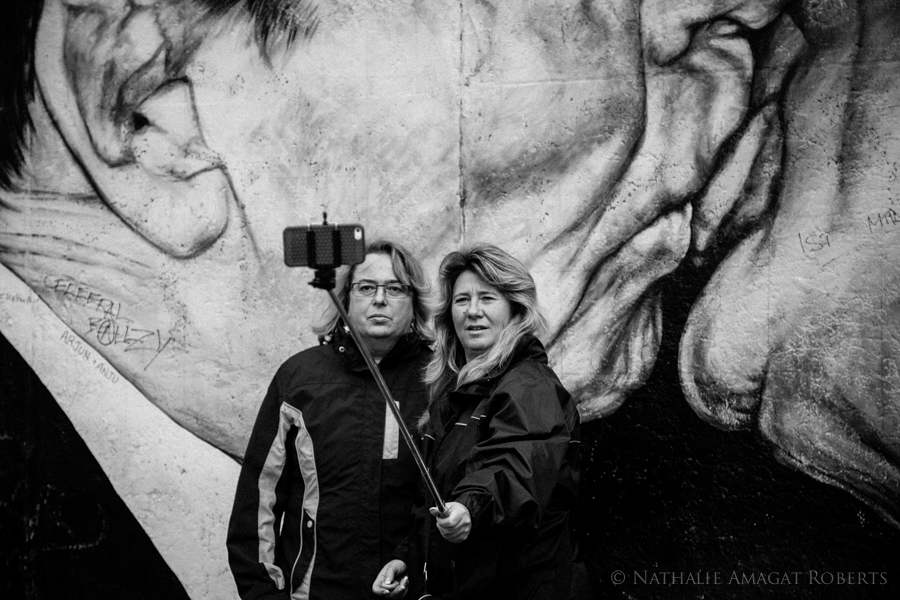
How ironic that it was being captured via a red phone at the end of a contraption made specifically for selfies. We looked on, with slight disbelief.
Another two women visiting Berlin, also recording time and place.
Each to their own, it’s a free world.

Memories can be wide angle or macro,
portraits of locals
or,
in 2014, selfies.
Images keep popping up.
Columns with dark bullet holes at the Neue Museum in the foreground are next door to a crane seen through a tall window against a white winter sky.
A perfect frame in my head, past and present in one shot.
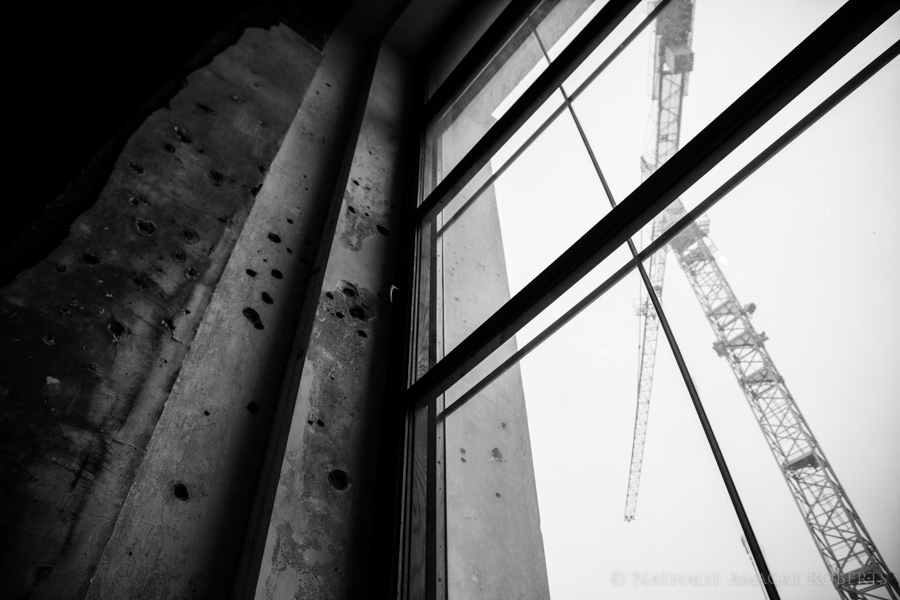
More images still are handed on a plate by street artists.
A small cut out of Dali is stuck under a bridge, a painting of the Queen (the British one) is hidden by colourful deckchairs stacked against a wall, waiting for a Berliner to take a rest from the hustle of the city in Monbijou park.
Yellow fists appear in improbable places, at the top of tall new buildings that can be seen from the U-Bahn, under bridges, as many up yours from East German street artist Matthias Wermke (Kripoe). A touch of anarchy in a city that only 26 years ago was half an occupied island in a Communist country, half a capital city of a Democratic Republic. What do you expect?
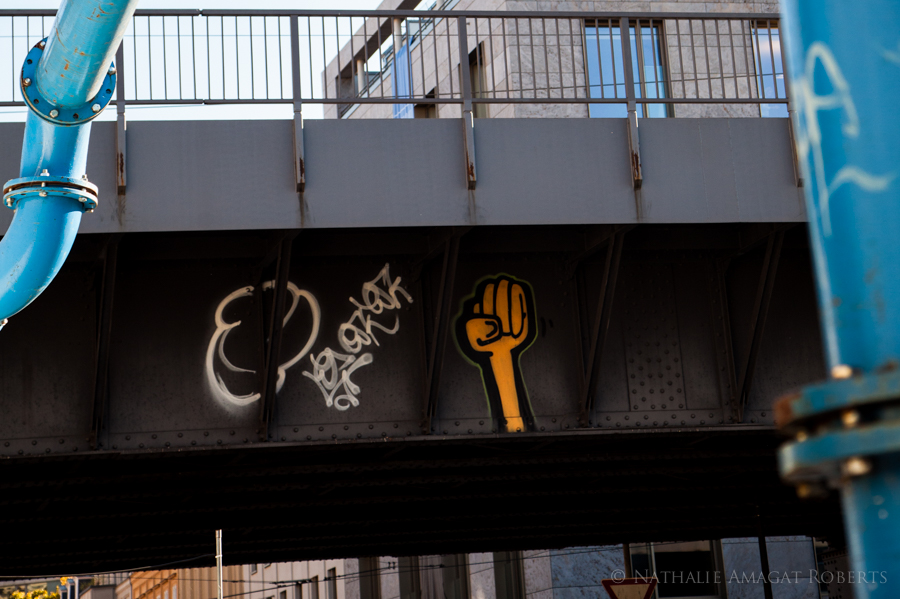
And now it is one, the capital of one of the richest country in the world.
In time, will Berlin’s history, our current European history, disappear forever to remain only in museums and galleries with Greek columns and concrete structures for parents to take their children and learn from the past?

If the atrocities that Hitler imposed on German artists and homosexuals -among others more widely remembered- are the back bone of how I see this city in 2014, the mind boggling divide imposed by the Allies after the war is the flesh that paints the Berlin that I feel.
When The Wall fell in 1989, artists flocked to East Berlin, occupying buildings that East Germany had ignored since 1945. Imagine 44 years of neglect, buildings gashed open, from humble homes to grand residences. Imagine being an artist at that time.

If experimentation was your muse and creativity rather than money was your driver, the possibilities were endless. Imagine being an artist now and living in Berlin, or visiting Berlin. It is visually stimulating, it is constantly changing, it still has areas where rent is cheap, it is forever reinventing itself. Kreuzberg and Schöneberg are the new go to places for creatives that think Mitte has moved on and sold to the tourists. Maybe. It’s still incredibly cheaper than London or Paris.
Berlin is fighting to keep the past alive and striving for a better future.

Whatever that may mean to a Berliner.
Whoever the real Berliners are.
Mitte is a place tourists head to for a slice of what used to be East Berlin. In 1989 artists headed East the minute they heard The Wall had fallen. They squatted empty buildings, made homes out of nothing, created art out of everything including Russian tanks and missiles, used the streets as perfect backdrops to extravagant live performances.
A new era was starting.
Tacheles on Oranienburger Strasse was originally built in 1909, a huge extravagant shopping complex in the Jewish quarter.
Eighty years later it was taken over by artists with much history in between.
In September 2014 Tacheles was sold for 150 million euros to Perella Weinberg Partners, a New York-based asset management company.
What happened in between?
When the original shopping complex went bankrupt, AEG took it over (and broadcasted the Berlin Olympics live in 1936, a first). It served as a central office for the SS, a prison for the Nazis, French prisoners hoarded in the attic. Most of it got bombed, Russian soldiers used the statues for target practice and tore down large chunks of what was left in the 1980’s. When artists took over the building in February 1990 they quickly founded an association and succeeded in getting Tacheles protected by the Historic Buildings Authority. The ruined statues are still there, for now.
It seems to matter not it was listed, 25,000 square-metres of apartments, shops and hotel rooms will follow.
Tacheles is no longer.

The other side of the gentrification coin.
A city divided still. Restaurants open up in courtyards and brand new hotels offer luxury at a price London could not even dream of, for now. Friedrichstrasse has a mixture of cheap eateries where workers lunch for around a fiver and upmarket restaurants where you won’t get a table on a Friday night unless you have booked.
You’d think posh Berlin eateries are the same as anywhere else. Not quite.
For a start, many restaurants only take cash.
Weird in our card and credit Western society huh?
Take The Pantry, in Mitte. Big art pieces on the walls, huge leather sofas, Asian European fusion cuisine that sounds pompous but is spot on, fun and fine dining in equal measures, impeccable service most restaurants could learn from, it is a place you sink in and don’t want to leave.
As I went to get more euros from the cash point, the waiter explained to my friend:
“The banks did not want to lend to us when we set The Pantry up. So when they asked for 8% commission we said F off”.
Right on.
Cash is fine.
“Oh no, I am so sorry your friend went to get cash, we could have given you a bill and you could have done a transfer”.
Trust people and fuck the banks.
Pardon my French, says the French woman, it was a German waiter that said it, in English, to my half Dutch British friend.
Europe in 2014.
Wunderbar.
Wonderland.

We happened to visit Berlin during European Month of Photography, not planned, just lucky. With 150 exhibition spaces we were never going to see everything in one visit. So we scratched the surface and headed for Mitte and its concentration of galleries.
Walking along Tucholskystrasse Andy Warhol stared at us from behind his shades and the back wall of Galerie Hiltawsky. Pin sharp white hair up in the air and half of the face pointedly lit from the right, only the grey top of the rim of the glasses a thin line on the left. Greg Norman’s blacks drew me in like deep holes of emptiness, his whites made me stand back and open my eyes wider. Stunning portraits.
It was interesting to check the prices, from 3,000 euros for limited editions of 25, which having just popped into a snotty gallery where five abstract prints that woke nothing in my heart or stomach were on sale for 25,000 euros put things in perspective.
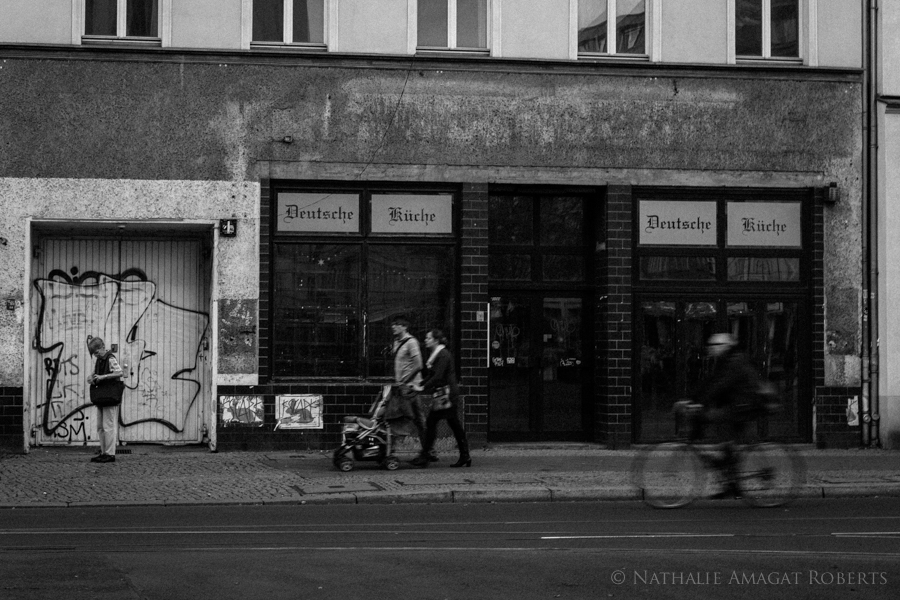
Mitte, 2014.
My favourite show was Berlin Wonderland: Wild Years Revisited, 1990-1996. Just outside, there were sleek galleries and inviting courtyard cafes. Inside was a room filled with gorgeous books published by Gestalten, beautiful and expensive designers’ objects, a long table and chairs where you could sit and read, a jug of fresh tap water with lemon slices a simple welcoming thought for the thirsty visitor.
At the back, the exhibition. Views of Mitte in the early years of reunification by artist photographers who lived in East Berlin at the time.
De Biel, Rauch, Recklinghause, Schilling, Schmundt, Trogish, Zöllner.
The images were not polished, the shots not always pin sharp. They were so much more. They informed of a time of change, they questioned, they inspired. They were beautifully printed on Baryta paper, in limited editions of 30. Starting at 300 euros for a 30×40 cm print, they portrayed a brief if intense history that shouldn’t be forgotten yet so few of us know anything about. Short lived movements can have a big impact in society. Bauhaus only lasted 14 years yet its influence on architecture, design and typography was substantial.

In Mitte, artists told me their story via black and white photography of a time that could not last.
This is where I learnt about the squatters, discovered Tacheles before stumbling upon the building on my way back home.
I’ll never know inside that alternative art space but at least I’ve captured the outside before it disappears forever.

Photographer friends,
Berlin is waiting for you now,
how will you see Marlene’s city?


Bibliography:
Berlin Wonderland: Wild years revisited, bobs airport, published by Gestalten
http://www.abandonedberlin.com/2010/04/tacheles-how-long-is-now.html
http://www.bbc.co.uk/news/world-europe-19473806
http://www.bloomberg.com/news/2014-09-25/perella-weinberg-buys-former-squatters-site-in-berlin.html
I came across Chideock’s catholic church by chance some years back.
A little path leads to a door flanked by two arches, a simple entrance not unlike a romanesque church that reminded me of a 13th century chapel you might find in the South of France.
As you walk on, emerging from under a canopy of leaves from the tall trees either side of the path, color hits you. There is Mary, her eyes raised to the sky above, as many a Catholic artwork. But this white statue above the door is against a painted backdrop of blue sky and golden stars and around her in a large roundel, eight painted medallions make a huge statement “This is a church like no other’.
It is a Catholic Church so you can expect Jesus on the cross and many a statue of Mary. Built in the 19th century, you won’t be surprised to find all sorts of artistic styles. That, and its interesting history, is what makes Our Lady Queen of Martyrs and St Ignatius of Loyola unique.

Raised in France where Catholicism is the main religion, it was fascinating to not only discover an extraordinary building but also its history, part of a bigger story of persecution. Hidden from the road by greenery, it feels like a secret venue but its apparent initial simplicity is lit by sparks of eccentricity and eclectic international artwork.

I’ve got a thing about churches, about what used to be, in most places, the centre of the community. Art and architecture draw me in, the people who built it make me want to stop, look around and listen. Raised by a Catholic family, I still light a candle and have a little thought for the ones I dearly miss.

Of course a Catholic church in England is not the centre of the village, it is the centre of a community that used to have to hide and Chideock is no exception. Thomas Weld of Lulworth bought Chideock estate in 1802 for his son Humphrey at a time when discretion was still called for despite the Reformation.
When the manor was built in 1805, the existing barn’s loft became a tiny chapel, it can still be visited today (by appointment). Its paintings, traveling altar and minute size tell a story of hiding. The walls of what is now the priest’s sacristy below the loft are totally decorated with murals and a 1929 painting by Fra Newbury of the Chideock Martyrs is inspired by portraits of the martyrs that can still be found around the church’s nave, below the upper windows.

What is unique about Chideock is that there was no architect involved. Charles Weld, Humphrey’s son, designed it and decorated most of it himself, with some help from his family.
Look closely and you’ll find a painting in an arch that was never finished, an almost ghost like figure; or Baroque inspired, slightly over the top, short white twisty marble columns encrusted with shiny stones and mosaics. You may think Corinthian when you observe the tall columns that hold the arches of the nave but look closer and its capitals (the sculptures at the top of the columns) are all different and were carved by Charles himself.

Several of the sculptures that catch your attention when you walk around were gathered during his travels. The German inscription on the painted Pieta at the back of the building is a giveaway to its origins and the white marble statues of Mary and St Joseph flanking the sanctuary at the front of the building are unsurprisingly Italian.

One of the most eye catching features is the gilded statue of Mary above the altar, almost floating towards heaven. Positioned under a skylight (and with a bit of help from human lighting too) she may be the first thing you see when you enter the church. Then again, we’re all different, there are so many details, inscriptions and little treasures to be found that you may see the high painted ceiling (barrel vault) or the imperfections in the treaded floor that leads you to the altar.
You’ll have to look around to find the baptismal font and its clever cover (check the wooden panelling too as it is from Westminster Abbey no less).
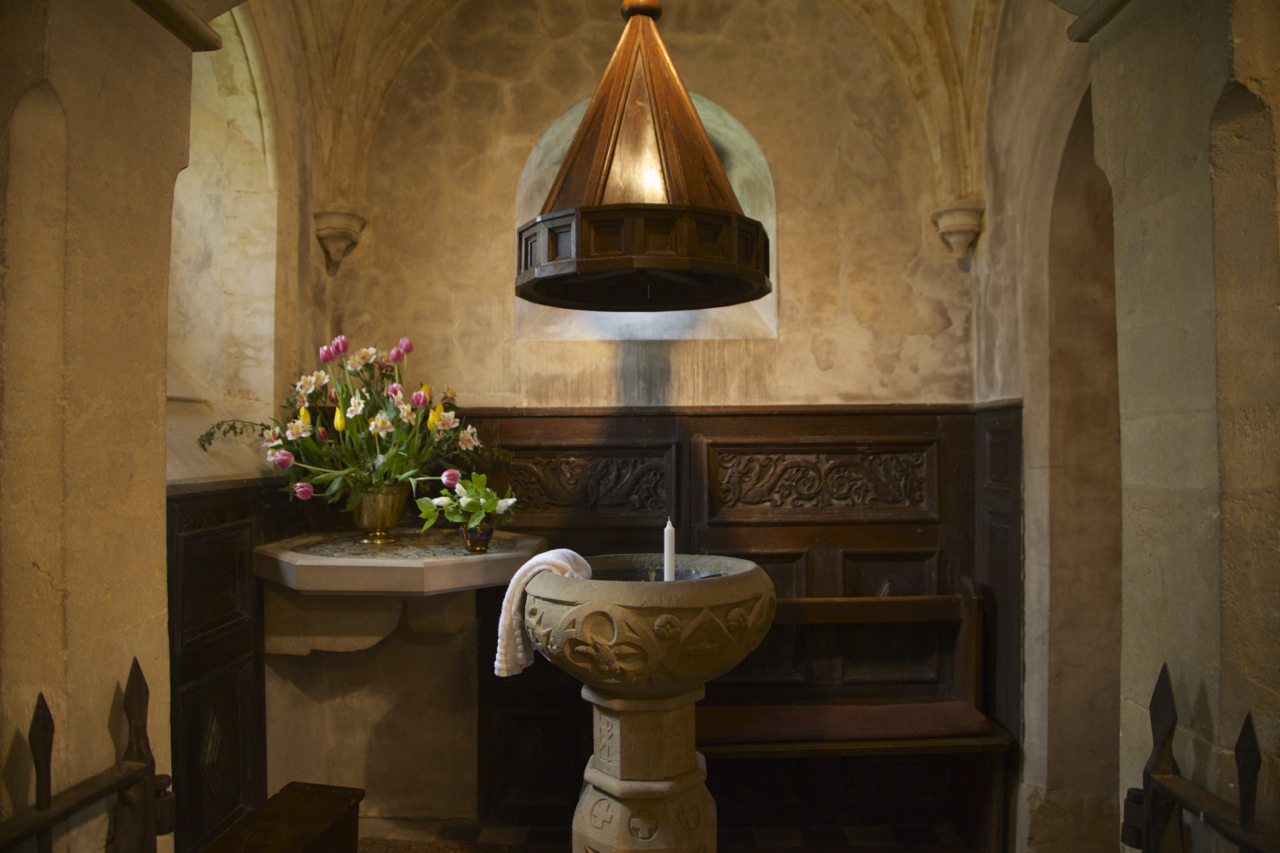
When I was commissioned to take photographs of the church I was lucky to be given a guided tour for my second visit. I won’t show you all the pictures although I took dozens, it would spoil the visit and the pleasure of discovering something you’ve never seen before. Look out for when they have open days to see the whole building.
In the church itself, there is plenty to see. You’ll find statues and paintings in alcoves, details in droves. Busy behind my lens capturing a mother in turn holding her baby or her grown son on her lap, I felt like time was stopping for a while, silence around me, away from our busy world, our religious differences.

Religious buildings have come to represent our differences in the world, something that pains many of us, yet when I visited this somewhat forgotten labour of love and faith, built by an English aristocrat for his community of believers, I felt a weird and unexpected sense of peace. It was (to my surprise) a descendant of Charles who gave me a tour of the church; her family still owns St Mary (although in trust). Private ownership of churches is one of the many things I learnt in Chideock.

Something I had never come across before either is a gallery overlooking the sanctuary for the Weld family to attend mass directly from the manor without being seen from the ground level. Although the family no longer owns Chideock manor, this is an interesting witness to a not so distant past. I must admit I found this feature rather strange, if fascinating, more to do with my French ancestry, of course, than my Catholic upbringing.
It made me think of history at large, social classes, lasting separations or forgotten divides. But it also reminded me that although churches are often a story of wealth enabling a building where beliefs can be shared and celebrated to exist, faith and even more so community involvement is now what is preserving the buildings for our future generations. As I visited, the cupola was about to be rebuilt and restored to how it used to be, thanks to funds raised locally over several years.
Craftsmanship prevails, wherever the funds come from, whoever the craftsmen are. Here, everybody can come and visit, light a candle, say a prayer or simply have a look around. I’ve only scratched the surface of what you can discover at Chideock catholic church. Whilst I was visiting, three men walked in and went straight to the little cloister adjacent to the church, now a local museum. In the silence of the church, it was easy to overhear their conversation.
Here was a father and his adult sons, looking at photographs of a person the older man knew many years ago when he lived in the area. The caretaker was called over to help. Now, was she the butcher’s daughter, or was she the one married to the builder? I left them to their conversation, the father with his revived memories, his sons, the lady of the church and the caretaker of St Mary.

We all walked back out at the same time a little while later, drizzle welcoming us to the English countryside, a smile on our faces.
I looked back at Mary in her roundel above the entrance.
Is that the sun shining behind her?
.
Fracking is a big issue. We’re all busy working, raising our kids best we can and don’t really have time to understand the pros and cons do we?
Are we being over cautious and blind to our necessities?
I’d say if you are going to put chemicals into the earth, it concerns me and you.
How do we know arsenic is not going to end up in our drinking water? Do we trust the government, the agencies and the energy companies to think long term rather than short term or look after us if it goes wrong? Who decides ultimately what our energy looks like tomorrow?
I tried to find facts, figures and what the pro and anti tell us; without being hysterical.
Simplified to bare minimum:
1. Drill further down than we have before onshore in this country
(approx 1km and over)
2. Inject water, sand and chemicals in thick metal pipes
(7 to 15 million litres per well)
3. Contaminated water comes back up, is then recycled or left on site
4. Extract the shale gas (for months or years)
5. Block the well by filling the hole with cement.
According to chemistryviews.org three to 12 chemicals are added to the water, 0.5 to 2% of the total amount of stuff that’s injected into the ground. At millions of litres of water per well, that’s large amounts of chemicals into the earth. Forget the worries of big holes we have been accumulating around the earth for years, we now have to think of chemicals coming into contact with layers of soil that have not encountered these chemicals before. I wish my chemistry teacher had warned me I’d need to understand chemical reactions at some point in my life.
From high levels of mercury around the Faroese archipelago to the drugs given to an increasing number of very young children for hyperactivity, some will say our governments have not helped us make informed decisions on what we do, what we buy and what we do to our planet.
It’s not a blame game, it’s a fact. And we’re not stupid or disinterested as we are often accused to be. The vast majority of people in the UK are busy working and are sadly despondent with politicians. But for the first time ever, we can raise our concerns and have a chance of being listened to. It has started, there’s been some U turns, it’s up to us to keep the momentum going. So what are the worries with fracking?
When Cuadrille started drilling near Blackpool in 2011, there were seismic events (highest being 2.3 on Richter scale). According to Cuadrille’s website the British Geological Survey said “The tremors were way too small to cause any damage”. Fair enough. On one site. What about when you multiply that by an unknown number?
In the US, Nationwide Mutual Insurance stated in 2012 it would not cover risk to farms from fracking (source frackfreedorset.org.uk). Some green organizations say, stop concentrating on earthquakes, that’s only a very small part.
OK, so what’s the bigger picture?
Apart from the governments setting up the rules from the experts’ findings, energy companies will be the ones drilling. Closest to home (in Southern England) is IGas with a license for shale gas in the Weald Basin.
According to their website, they want to play their part in diversifying Britain’s energy mix and have been extracting oil and gas for 30 years. They know what they’re doing. They have not had any catastrophe. Fair enough. We’ve been using their energy to heat our homes for years.
They are working within the new UKOOG charter that will ensure communities will receive a share in the benefits that shale gas may bring.
That sounds good, financially, so how does it work?
UKOOG United Kingdom Onshore Operators Group published industry guidelines to include hydraulic fracturing and the public disclosure of fracture fluid composition. So, fracking will be regulated, and they’ll have to tell us what chemicals they’re using.
UKOOG has also published an engagement charter, they promise £100,000 for the community situated near an exploratory fracking site (whatever the outcome) and 1% of the production revenues (before the operator has accounted for their costs). Evidence will be published and as the industry develops, they are pledging to consult further with local communities. These funds will be distributed via the UK Communities Foundation.
My local one, the Dorset Community Foundation, works with private and corporate donors. It has distributed £10m in charitable grants since 2000. The Bridport Rowing Club received £1,567 in October 2013, the Dorset writers’ network £5,250 in April 2013, the Drimpton Hall £1,000 in 2013, the Beaminster Area Seniors £1,500 in July 2012.
If we had fracking on our doorstep, more money would mean more help. What do financially struggling small charities think about that? £100,000 is very tempting in the least and a tiny portion could mean the survival of a struggling small local charity. Some will see it as a form of bribery, others a necessary evil.
According to UKOOG, in areas of scenic beauty operations will be screened and the site restored to its previous state once operations are finished. The average site of a drilling rig is 125 ft (38 m) and is needed for an average of 12 weeks. The water needed is 100-300 trucks movements per year per ‘pad’ (area around the well) over 20 years.
As a comparison, UKOOG use the 11 million m3 of milk produced in the UK by dairy farmers representing 370,000 truck journeys yearly. As nobody knows how many pads there will be, nobody knows how many trucks will be driving around our roads.
Exploration sites are preferably 24 hour operations with floodlights. Noise is kept to the minimum possible. Whilst I live in an Area of Outstanding Beauty, these localised nuisances must not detract us from looking at the bigger picture. Sadly they often do. There are questions that will have a far wider and deeper impact.
The Royal Society advised the Government specifically for shale gas. A few extracts from their advice in 2012.
‘It is mandatory for operators to submit reports about accidents and incidents to the UK’s regulators. Reports should also be shared between operators. Reliable data on failures of well integrity, as well as failures or shortcomings in procedures carried out during well construction, operation and abandonment, are not readily available.’
(To be fair, the UK have not been doing this for years -as the US have- so cannot be expected to have these records)
‘These data should not be proprietary to any one company. Commercial confidentiality or the prospect of adverse publicity should not become barriers to sharing data and learning from incident experience. The importance of an open sharing and learning culture is clear from investigations into past oil and gas incidents.’
This, in theory, should enable us to be as safe as possible. I use should as governments and companies use could (provide jobs, provide enough energy for the next 50 years).
But are these the most important questions? What about the long term effects for my kids and theirs? We have to look at that greyest of grey area, climate change.
The RA further advises:
‘Policymaking would benefit from research into the climate risks associated with the extraction and subsequent use of shale gas. Policy making would also benefit from research into the public acceptability of shale gas extraction and use in the context of wider UK policies, including:
‘There are few reliable estimates of the carbon footprint of shale gas extraction and use in the peer reviewed literature. One US study from Cornell University concluded that the carbon footprint of shale gas extraction is significantly larger than from conventional gas extraction owing to potential leakages of methane’ (Howarth et al 2011). ‘The same study recognised the large uncertainty in quantifying these methane leakages, highlighting that further research is needed’. (Source RA)
The UK government indicate that carbon footprint from shale gas extraction is lower than coal extraction and that methane leaks were mainly due to bad well design or maintenance. The UK therefore will be learning from past mistakes and we can trust risks will be minimised. Research is still carrying on specifically on climate change and how to transform the methane into useable energy.
The guidelines set out that ‘operators must publicly disclose all chemical additives to fracturing fluids on a well-by-well basis, including regulatory authorisations, safety data and maximum concentrations and volumes. These disclosures meet or exceed all known standards in the global shale gas industry’. (UKOOG)
The government has set out to lead the world on best practice for shale gas extraction. They and therefore we have to rely on the companies that will extract.
The pioneer company in the UK is Cuadrilla. Based in the north of England, Cuadrilla is a network of limited companies in different countries, a typical multinational. Cuadrila claim they ‘could create 5,600 jobs in the UK, 1,700 of these in Lancashire’. They also claim that natural gas is an ideal transition fuel and as they receive no public funding, no money is being taken away from funding renewable energy. Cuadrilla Resources Ltd is privately owned by its management team and two investors, AJ Lucas and Riverstone LLC.
When we deal with companies, we obviously deal with people. Cuadrilla’s Chairman is John Browne, ex Group Chief Executive at BP. He is a member of the House of Lords. He is Chairman at Riverstone Holdings LLC (energy private investment firm with $27 billion of equity capital raised, one of Cuadrilla’s investors), Director at Fairfiled Energy Ltd, White Rose Energy Ventures LLP (both oil and gas), Director at Pattern Energy Group (wind and transmission company). He is also chairman of the advisory board at Stanhope Capital, advises Deutsche Bank on climate change and gets book royalties from Weidenfeld & Nicolson.
According to his autobiography ‘Beyond Business’ he invented the oil ‘supermajor’ and led the way on issues such as climate change, human rights and transparency.
Companies and governments like to talk jobs. Cuadrilla could create 5,600 jobs although it is not clear whether these are for drilling (short term) or extracting (longer term).
To compare to a company that operates in the energy market currently, IGas employ 170 staff over 100 sites in the UK.
Companies also pay taxes into the Exchequer. In 2012 BP paid $1.1bn in corporate income and production taxes according to their global website. According to a thisismoney.co.uk article BP have 67 companies registered in offshore territories (for 85 subsidiaries) too. Energy and commerce are indeed international but we cannot ignore the energy companies’ share of our national budget.
The Government wants investment to come to the UK. They promise English local authorities 100% of business rates collected from shale gas schemes rather than the usual 50%. Cameron claims the process could support 74,000 jobs and reduce bills. Could.
Recently at the World Economic Forum David Cameron has made it clear he does not want the EU to add more stringent rules for fracking companies. Does this means our current rules are stringent enough to safeguard us from companies that will put profit before people’s safety? We can only go on past experience and make up our own mind.
Although undoubtedly welcome, some may find Ed Davey’s timing on looking into British Gas interesting. Our Secretary of State for Energy and Climate Change is asking the regulator to look into why British Gas are so expensive whilst holding 41% of the national share of customers. Better late than never some will say; others -as it happens one of the big 6 energy companies- say that he is meddling in the affairs of the regulator and he should not (The regulator are due to give a report shortly. Source BBC). If the government cannot take action when they are told by the people who elect them that there is a problem, then are we safe with these regulators?
It seems to me our Energy Minister had no choice, he will not be able to sell us the idea of fracking without tackling the big issues consumers currently have with the current energy companies. And British Gas has been a bone of contention with many for years. Only with fracking, it won’t be a case of swapping supplier.
Nobody denies that we are dealing with highly toxic and carcinogenic chemicals and a method of extraction that has very little data. As it stands, we have to trust that the Oil and Gas industry will be more responsible than in the past.
If each well only has one or two people on site, we have to trust that each and every individual working for the company will not try and cover an accident, say an arsenic spill for fear of losing his or her job. Accidents happen and should not stop progress. True. There will be monitoring for levels of chemicals in our aquifer (where our drinking water comes from) of course, but is that enough?
Drilling more than a thousand metres below the surface is new to the UK, the US have only been doing it for a few years (they claim they’ve been doing it for a long time but does a few decades give us an understanding of the consequences of fracking for the generations to come?).
Nobody denies that there will be increased radon and Naturally Occurring Radioactive Material in the air and the water. It will be monitored locally so it should be OK. When will we know the real impact of the Fukushima nuclear power plant disaster? If we keep adding even minute amounts of bad stuff internationally, on and on, and on, when will the balance tip to danger or even, let’s go hysterical, disaster?
Where will the huge amounts of water needed come from? This is probably the least of our worry in this country, let’s face it, water source should never be an issue, although sometimes it is. Water bans in the UK have always puzzled me but we’ve had them.
It is not clear yet how flowback water (with its toxic chemicals) will be recycled, the US have had open pits (with obvious problems), containers above ground (a potential temptation for a wicked mind?) or put it back underground. Can we be safe in the knowledge that the ground layers around these contaminated waters will not react to the new chemicals that have been injected? Listen to whichever specialist you want, they don’t agree anyway. I can’t help but worry.
If companies invest in shale gas will they invest in green energy or research into better methods? Lord Browne assures us that one does not take away from the other. That’s as it may be, the big world of commerce is beyond my understanding.
It is worth noting nevertheless, that in June 2013 Centrica Plc (aka British Gas) paid £40 million in cash and became an investment partner in Cuadrilla in Lancashire. Big companies won’t put all their eggs in one basket, I understand that much, but if one basket disappears, then maybe investors will put their money into other baskets; maybe the ones that are investing in cleaner energies. Their return may not be as high, but where have high returns led us in the past?
Companies are there to make money. People who are lucky enough to have money to spend, have enough education to be informed and are free to choose help create the markets companies will want to invest in. As more and more people realise this and share information, we can only hope we all make better informed decisions. We do have a choice.
Do we really understand climate change? I don’t. Sorry. The problem with climate change, for most of us, even the ones who have gone to Uni but did not study maths or science, is that it goes beyond our every day understanding. Did you know that physicists started warning us about greenhouse effect in the middle of the 19th century?
All over the world scientists have been warning us ever since with new findings to back up their theories. And to this day, loud voices still spread doubt.
Is it now time to help the big hungry machine of western society say stop?
Breathe.
Think.
Learn from our mistakes.
We are in the middle of devastating floods.
Why?
Let’s look at where we are now and what we (Joe Public) know. We’ve built on flood plains, we’ve taken the hedges away, we’ve put concrete and tarmac all over the show and we know that when the ground is saturated, water will find its course to the lowest point. Joe Public have been saying this for years. Country folks sure have.
So why did we build in the flood plains in the first place? Did the scientists not warn us? Was it the cheapest way out of a housing crisis? Whatever the reasons, we probably felt we had no choice.
Flood defenses may be the answer to dealing with this crisis now. But who listened to the country folks who said stop taking our hedges away or the top soil will disappear into the rivers? Who listened to the scientists who said monoculture is dangerous for the future of the ground? Did farmers have any choice? How many farmers who tried to go organic early on survive? How many small farmers have survived full stop. These were choices made for housing and eating. Yes I know industrial revolution, feeding the world and all that. We’re now being convinced that we need shale gas to heat our homes and cook for our children. Do we?
What will be our flood defenses for shale gas, if in 75 years we realise we have gone too far? Will we merely be shut up and told ‘this is not A Level chemistry’?
We have a choice, and the British Government is telling us to use common sense. Things are changing.
The internet is changing things.
We know that there were snippers in Kiev.
If history was written by Kings’ scribes in the past, current history is being written and filmed by everybody. We can reach our governments, they cannot keep ignoring us. If we don’t make the most of this, then what next?
At the moment, I’d say the UK government is realising that its people and their petitions cannot be ignored all the time. Not all ministers have clocked social media feedback yet but fact is they’re flocking to twitter (almost flocking and definitely yet to understand how it works but you know, one step at a time), some still think that people who sign petitions are stupid, but then where I live Town Council voted against monthly meetings’ information being sent by email in 2013. Yes. Seriously. Let’s keep printing reams of paper, collate, staple, deliver and pay somebody to do this. And increase our Council Tax. I digress but I had to tell you. You need to know these things. How else will we ever evolve?
Back at national level, it is a good thing British Gas is finally being investigated. It is a good thing we have a government that does listen to us -as well as the lobbies of course-, whether you call it a U turn, vote swaying or listening. And no, I am not a member of the Conservative party. I don’t care who is in government, they’re all individuals who have to make decisions. And like us, they need the information to help them decide. Forget the bad apples, they’re everywhere and distracting us from taking action. Let’s not use them as a good excuse for apathy, we’ve been doing this long enough on too many subjects.
We do not have enough information yet to understand what we are doing to our finite earth. We may never do. Meanwhile, we need to decide what to do with the information we have. Renewables are not perfect but if I have to choose between unsightly and arsenic, I’ll choose an ugly turbine. If I have to choose between unspoiled grassland and solar panels, I’ll choose solar because when a better solution is found, the solar farm can be dismantled and the grassland won’t have disappeared forever. And yes, I realise that we need to extract minerals or metals for renewables’ engineering and that there are consequences there too. This is what we have to play with at the moment, whilst our government tries to convince us that fracking is a good idea.
I cannot help but get increasingly frustrated in my rural heaven by all the No to wind turbines, No to solar farms, No to anaerobic converters, No to fracking, No to emails.
Yes to what then?
Scotland getting the North Sea Oil?
That decision is in somebody else’s hands. A few months away, it may be Goodbye North Sea Oil, Bonjour EDF who in forty years have still not found where to safely store nuclear waste. If we know that one thing is, to the best of our knowledge, more dangerous than the other which one should we go for?
Bonne chance England.
——
Sources:
http://www.ukoog.org.uk/community/benefits
https://www.gov.uk/government/speeches/the-myths-and-realities-of-shale-gas-exploration
http://www.dangersoffracking.com
http://www.energyfromshale.org
http://www.psg.deloitte.co.uk/NewsLicensingRounds_GB_ON_0806.asp
http://www.hpa.org.uk/webc/HPAwebFile/HPAweb_C/1317140158707
http://www.parliament.uk/biographies/lords/lord-browne-of-madingley/2172
. How on earth can Faroese people slaughter whales like that? A bloody cove, neat lines of dead fish along a red beach, kids sitting on a whale whilst Mum takes a photo.
Sick.
You’ve seen the images haven’t you, they’ve been doing the rounds on social media. I shared the images. ‘Be careful with this’ said a friend. The Faroese people are far closer to the sea and nature than we are.
That stopped me in my ‘people need to know about these things’ track.
Why did I share the bloody cove from the dozens of emails, petitions and good causes that I receive daily?
I tell you what got me. It was the kid sitting on the dead whale like he was riding a wooden horse at a fair whilst his mum was taking a picture; then reading that young untrained Faroese men use a hook to get the whales onto the beach, so the animals suffer from this ancient ritual, this right of passage that has not changed, allegedly, since Viking times.
What got me further was that their own governments have told Faroese islanders not to eat the meat more than once a month because it’s too contaminated. So if they can’t eat it anyway, why on earth are they still killing the animals? What do they do with all that meat anyway?
Thing is, are these the real questions?
Why is their fish so badly contaminated when they live in some of the cleanest waters on earth?
What will Faroese people do without their salted local fish, their winter protein and fat stash?
What do we – westerners, oft judgmental and let’s face it sometimes misinformed – know about this archipelago not that far from the Scottish shores yet close enough to Iceland?
The Faroese people have been advised by their government to only eat pilot whale once a month because it has high levels of mercury so is dangerous for human consumption. Pregnant women must not eat it for fear of damaging their unborn baby’s brain forever.
How did the mercury get there?
No-no-no said my friend who, like all farmers, knows a thing or two about chemistry. We don’t use mercury anymore, it’s dangerous. I know, we don’t have it in thermometers anymore, but it’s still being used. So I referred him to the Royal Society of Chemistry who tell us that mercury is still widely used to make advertising signs, pesticides, dental work or batteries. English farmer friend shook his head in disbelief.
There is no way the Faroe Islands will be at the top of the list of nations that pollute the most. (I realise the Faroe Islands are not really a nation but that’s beside the point, let’s get back to that bloody cove).
Let’s forget the blood for a minute
Abattoirs don’t give us photos of the rivers of red stuff they generate and have to dispose of when they butcher our Sunday roasts; or the mince for our burger chains. Yes I know, out in the open, blood is a shocking sight. And I fell for it. Even my friend who hunts shared the photos, and he knows a bit more about killing than I do. I just eat the stuff, I don’t kill it.
1000 whales. How many fish fingers in the UK, Europe, the World?
The Faroese are a sea nation, as are the British. 95% of the total Faroese goods export is fishery products, we’ve probably eaten some of their farmed salmon.
Yet when I read untrained young men slaughter around 1,000 pilot whales per year, my western brain imagined our city teenagers let loose with a large hook. Not a pretty sight. I wasn’t really thinking of the Faroese boys who are likely to have gone fishing with their fathers and brothers from a very young age, who understand fishing, who respect the sea and its produce and fish once a year to provide protein and fat for the whole year.
The Faroese government have introduced new regulations to ensure that the pilot whales caught are killed as quickly as possible (a spinal lance, killing time 1-2 seconds) by fishermen who have attended a certified course of instruction in the current whaling regulations. That’s a either a step in the right direction or the government adding paperwork because they’ve been asked, yet again, to regulate. That old balancing act.
We still have the issue that whales are being killed. They’re probably endangered as most big mammals are these days, right? Wrong. Several websites estimate the long-finned pilot whale population to around one million. Pilot-whales are not mentioned on the WWF list of endangered cetaceans. Whether whaling is right or wrong is another matter.
According to their website, the WWF are not trying to stop whaling, they aim to end uncontrolled commercial whaling. Whilst we’re busy pointing the finger at the Faroe Island’s bloody coves, we want people to shop local. The fish caught in Weymouth was going to Spain when I last spoke to a fisherman, a couple of years ago (2012). I wonder how much mercury there was in that fish.
Thousands of people will have seen the bloody pictures from the Faroe Islands. Very few will come across this post, let alone read it all the way down to here. Thank you for being one of the few. Maybe like me you’ll now wonder why we keep coming across this tiny island and its fishing practice, yet the full content of the fish -or the fish fingers- we feed our children is something we know so little about.
“Are you a Communist?”
The man stared at me as if trying to get through my eyes and dig into my mind, making sure no lie would come out of my mouth. The voice was deep, the words were spat out with disdain.
Had I done something wrong? I was a little bit scared. I didn’t quite understand the question, or why he asked, I’d never been asked what my political views were by some stranger; what did it matter anyway? Who did he think I might be? A spy?
We’d talked politics at home, a bit, and at school a bit more, but to me it was all bollocks anyway and my political interests were more comedian Coluche and singer Balavoine who attacked the political elite on television and were far more interesting than the same old suited men who made very little sense. Artists were the ones that talked straight, questioning the politicians stuck in their own world, way away from what young people wanted, mainly peace. I sure wasn’t a member of any party, so to call me a Communist just struck me as a stupid question.
All of seventeen, probably the equivalent of a thirteen or fourteen year old that I would know today, the furthest away from home I’d ever been, I had arrived in New York with a plane load of Swiss teenagers bound for a year away from home.
I’d chosen Canada and I was the only French fish in a sea of Swissness. All the Swiss passports were glanced at, quickly stamped and the Swiss kids got a nod and off they went in an orderly queue towards the open doors behind the custom officers. No questions asked.
Meanwhile, this man was staring at my passport, and in turn at me, making a bit of a show of it all. I probably got very red in the face, annoying habit of mine, and opened my eyes wide, automatic habit of mine when faced with a challenging question, especially when somebody is being aggressive, which he was.
“Well no. I’m not.” I paused. Then asked: “Why?” A bit unwise I grant you, but then at that age, why should I have been wise? Why indeed, still my favourite question, yet so often leads to such unsatisfactory answers.
“Because you have a Communist president” he replied, his face a cross between angry and condescending.
How weird, I thought. It was 1982. France had decided to swing to the left with President Mitterand the year before. With just over 51%, he was the first Socialist president since 1959 but I had no idea that it may be significant outside of my country. With my little interest in politics and the old people who ran the country, I knew that my president was a Socialist. Marchais was the Communist one, and he’d lost in the first round. What was this man on about?
“No. President Mitterand is Socialist, not Communist, and I am not a Communist”. He was still staring at me, doubting my words, obviously, I realise now. I could feel his hostility in my bones and I had no idea why.
He handed my passport back. “Socialists, Communists, French…” he mumbled as if spitting, firing insults like bullets stuck together. His colleague was smiling at the last Swiss kid, welcomed in, unquestioned. I took my passport, thanked him, I think, automatic reaction, and moved on to join the group of young people I had just met hours before at Geneva airport; they, all smile and excitement to finally have made it to the United States of America after a year of interviews, meetings, bonding exercises and doubts; me, a little bit shaken.
I never did get a ‘Welcome to the United States of America’ but then again, I was heading for Canada. I sometimes wonder, had I spent a year in the USA instead, would my views of that country be different now? I was ‘saved’ from living with a Canadian Mormon family by a Canadian Catholic family because of religious values, I was questioned by that American Customs officers because of orders from above, I was bullied by English speaking Canadian kids on the yellow school bus for weeks because I had a French accent so they assumed I was French Québécoise.
I was part of an international exchange charity whose aim is to promote peace and understanding between countries, AFS, who celebrated 100 years in 2014. And do you know what? It was one of the very best gifts my parents ever gave me. Open the door and let me fly. Go and discover the world. It’s a bit scary at times, it’s a challenge of course, but with hindsight and more years in yet another country under my belt, I’ve realised that we all have prejudices. Travelling taught me to try and not judge, we’re all trying to do our best with the beliefs we were brought up with. I don’t always succeed, I still struggle with narrow minded Americans, but it’s a big country, they’re not all bad, neither are all French perfect, or Communists.
Quelle surprise!
Morning sun, blue skies, birds tweeting…

 Pardon my Franglais